
The blurred self image of progressive climate villains
Watch a video summary of this blog post here
Furiously making more fossil fuels available by opening up a slew of massive new carbon bomb projects results in far greater usage of them compared to a world where we constrain and wind down supply. The world where we keep whipping the carbon tap wider and wider ends up worse than the world where carefully begin to close it. Fossil oversupply isn’t the only thing causing climate change, but holy hell is it a big chunk of why we’re struggling to reign in demand.
The guilt for this act isn’t evenly distributed. Australia is comfortably in the top few of the world’s worst (along with the place I actually live, Norway).
Countries like Norway, Australia, Canada and the United States export vast volumes of planet heating products, but their centrist governments attend climate meetings with the comfortable, happy swagger of fake leadership.
Progressive climate villains pushing out toxic positivity are a special kind of evil. They are worth paying attention to.
When Australia’s government recently approved three new coal mines it was a moment of incredible significance, and red hot outrage.
The approvals also come at a time when Prime Minister Anthony Albanese and Climate minister Chris Bowen are feeling self-conscious, because they’re lobbying to host COP31 in 2026, with government representatives flying to Azerbaijan in a few weeks to lobby their case at the upcoming COP29 meeting.
The plan for COP31 is to co-host with Pacific Islands nations, but this coal mine announcement has undermined that. “When a member of your family is sinking, you help them to safety. You do not push their head further down into the water”, said Alopi Latukefu, director of the Edmund Rice Centre for Justice and Community Education.
More locally, Environment Minister Tanya Plibersek, will host the “global nature positive summit” this week, and that event really does feature some big names in sustainability and global climate diplomacy. This announcement is going to loom large, and there will no doubt be protests.
After the outpouring of grief and outrage at the approval of three new coal mines, Australia’s environment minister tried posting through it by sharing this on Instagram:

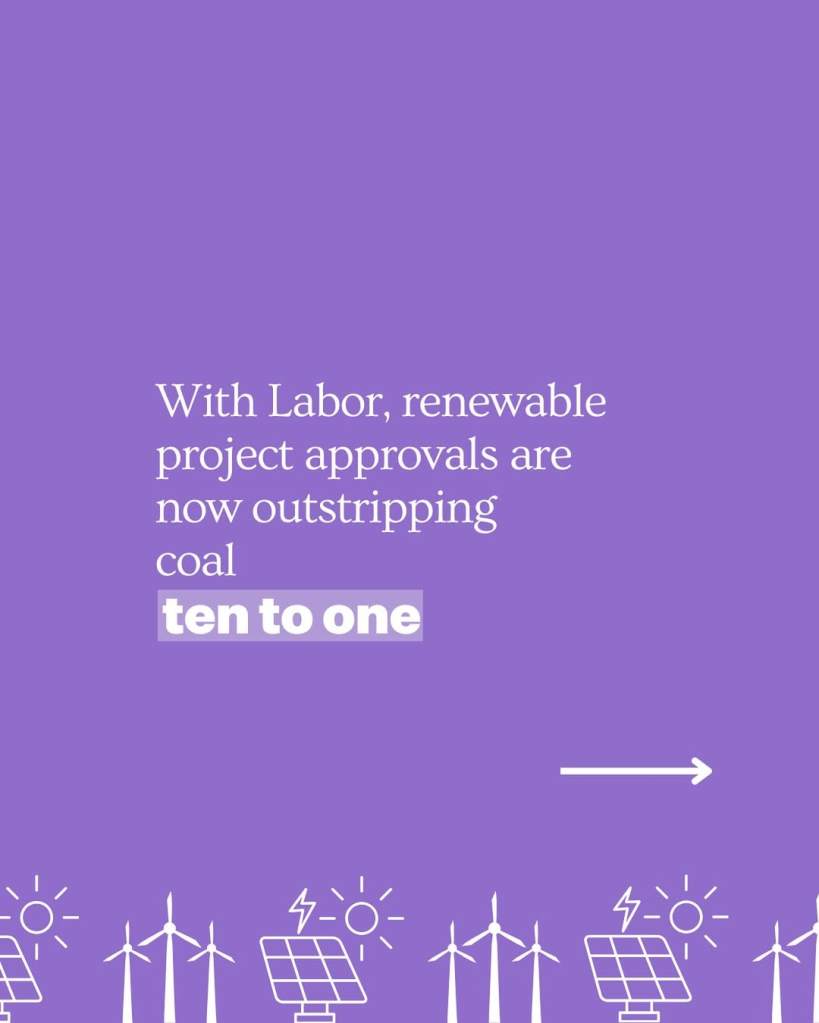

The implication here is that the Albanese government has quickly flipped the script: switching from fossil fuels to renewable exports so huge that the country is on track to becoming a ‘renewable superpower’. That is one hell of a story they’re telling. It is obviously a core talking point now; offered as a comment in this article too (Plibersek’s office has form on this).
Good news for you: I’ve got some numbers.
Here are some fun facts about Australia’s government
Over nearly a decade, the previous conservative Liberal government oversaw a shocking expansion of both the coal and gas extraction industries in Australia. It was fuelled by subsidies, corruption and greed. Since being elected more than two years ago, the Albanese government slid in at what seemed to be a downward inflection of the curve, and oversaw it being switched back to fossil export growth.
The government’s recently released projections show1 that the plan is to continue that increase in exported climate damage, bringing fossil fuel exports back up to the Scott Morrison peak and perhaps even higher:

Let’s start with my headline result here: Albanese’s government has overseen the export of more fossil fuels in their first two years than the previous Liberal party did in their first two years. Not by much – but they’re technically ahead2:
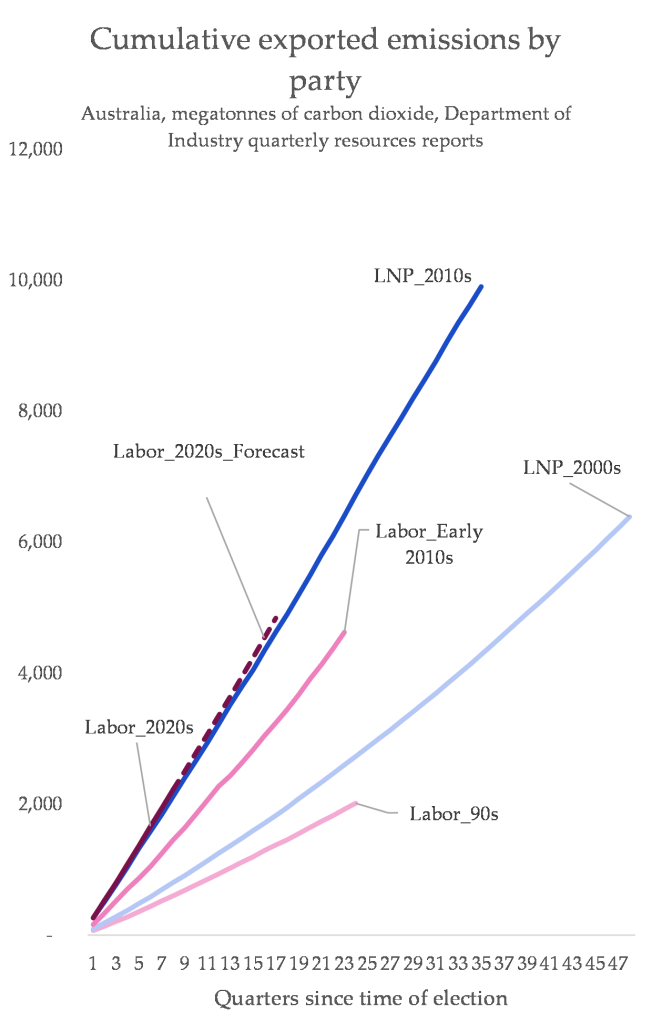
We can already see Plibersek’s comparison is misleading: they are worse than the previous government in terms of fossil exports. Even if the number of new coal mines approved is lower, they are still overseeing the sale of a greater amount3 of dangerous fuel.
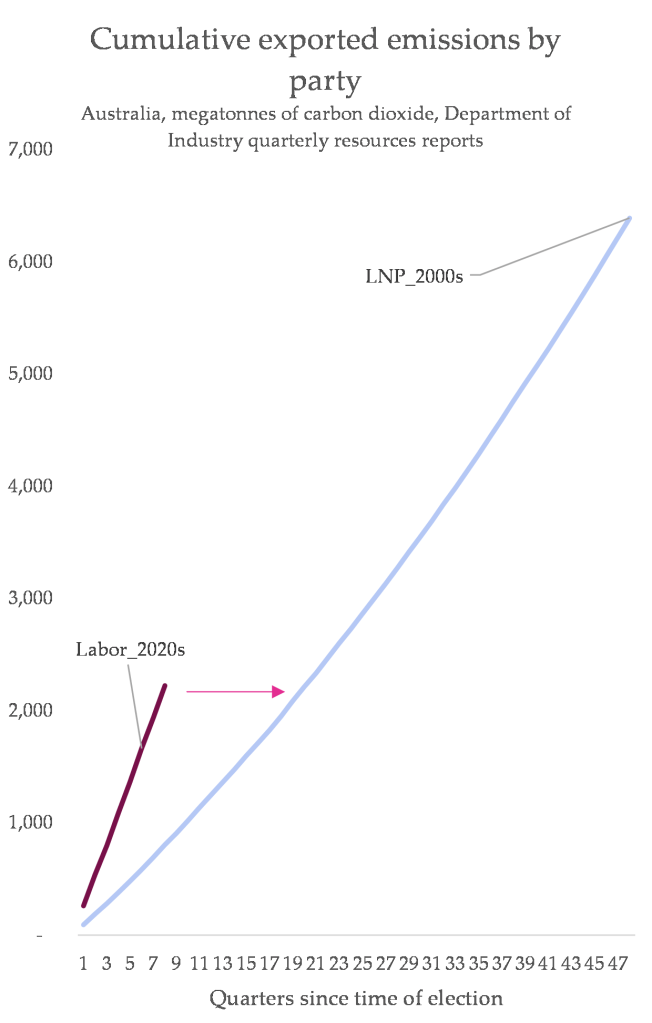
Here’s another fun fact: Albanese’s government has overseen in two years the export of an amount of fossil fuels that it took the Howard government more than four years to reach:
If you look just at fossil gas, the fossil fuel that is growing at the fastest rate globally, the picture is even worse.
In the first two years of the Albanese government, Australia exported more than three times as much as the previous Liberal party did in their first two years. And in Albanese’s first two years, more fossil gas was exported than any previous Labor government or the Howard government exported during each of their entire terms in power.
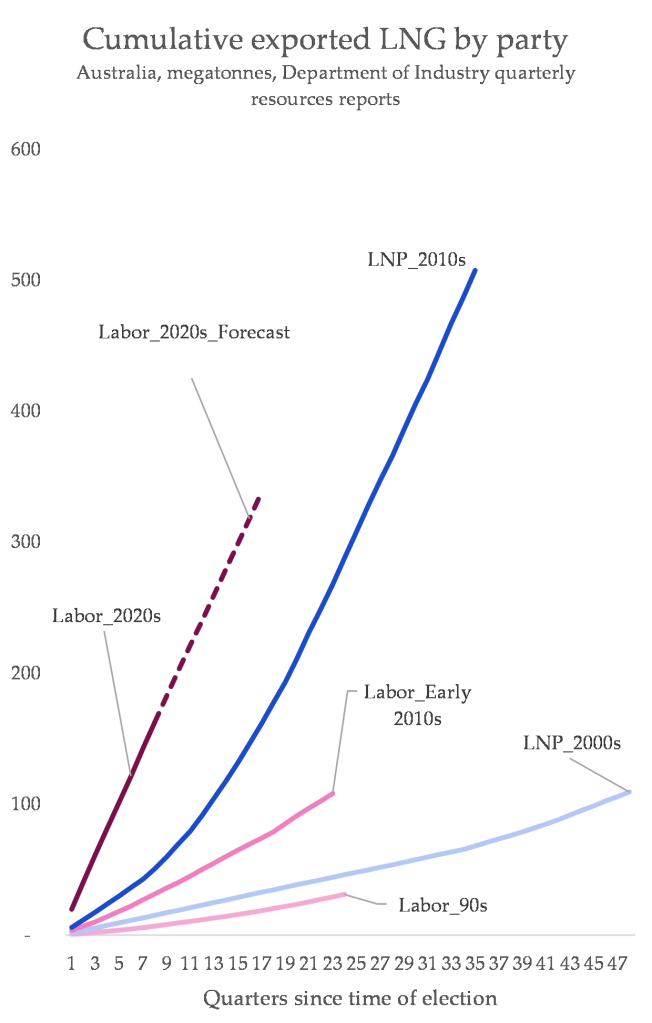
To summarise: the Albanese government has overseen the export of more fossil fuels in their first two years than every government prior did in the same time period after being elected.
Okay, real talk. I know Anthony Albanese doesn’t sit in a room next to Chris Bowen, directly controlling precise coal and gas export quantities. But their influence on the industry is massive – a suite of policy mechanisms overwhelmingly encourage the extraction and sale of fossil fuels, maintaining the nightmare created by the previous government.
And if Plibersek’s staffers making Insta content are claiming to have downwards-influenced coal mine approvals, it seems like a tacit admission that, yes, they too realise that they have the capability to influence the growth and contraction of new fossil fuel supply in Australia. They just want to say they’ve done it, rather than actually do it.
Renewable energy superpower
Perhaps the upwards curve of exported emissions is cancelled out by an even steeper growth of domestic renewable energy, as Plibersek’s staffers imply in the talking points they’ve created.
Australia’s average emissions reductions for the power sector during Albanese’s time as PM have been about 0.9 MTCO2-e:
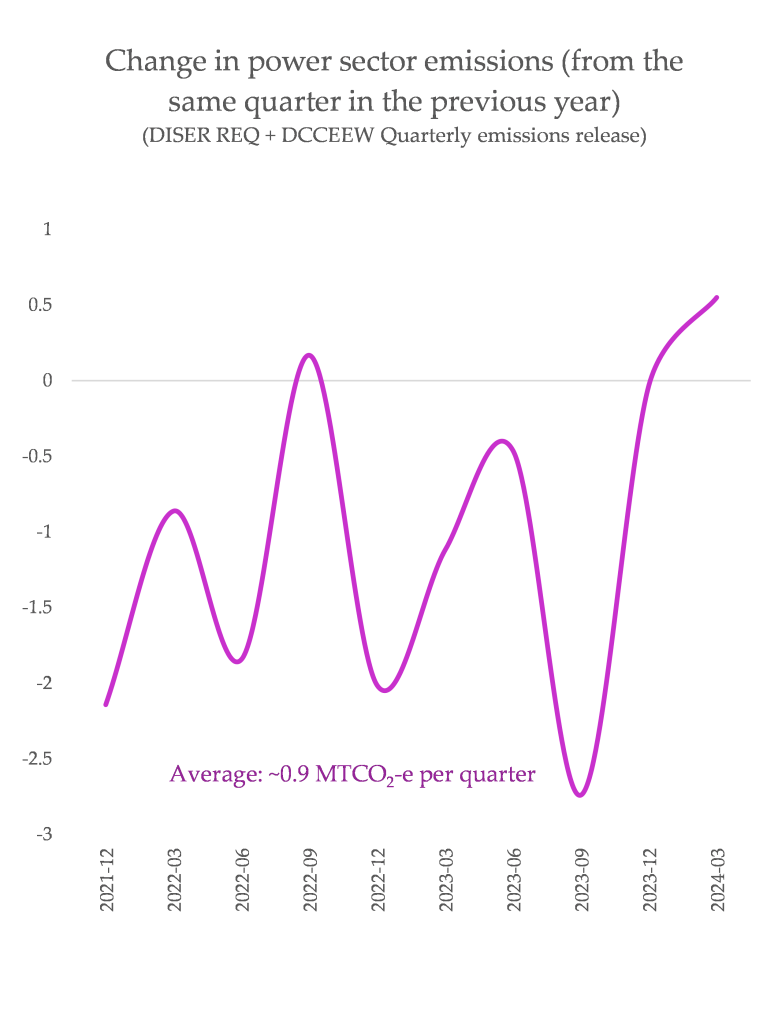
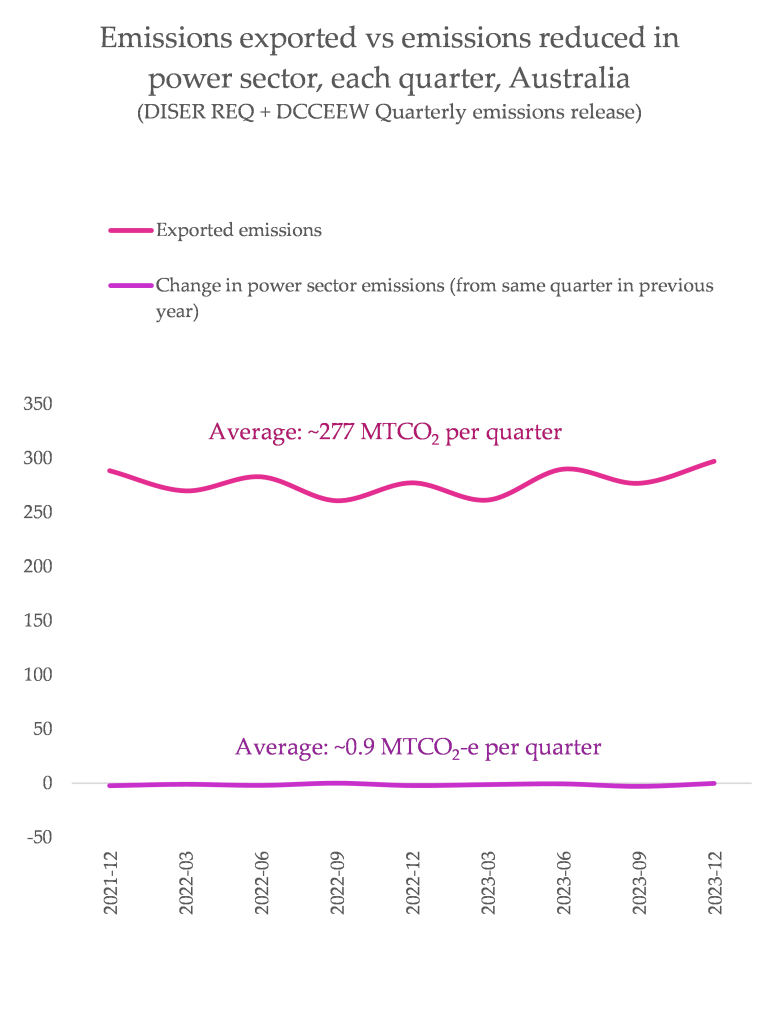
To put this in context: the average emissions from fossil fuels exported each quarter are about 275 MTCO2-e. Not only is the Albanese government’s renewable energy growth not offsetting fossil exports, the fossil export industry does about 300 times more climate damage than domestic renewables avoid:
To make things worse (sorry), Australia’s clean energy deployment has seen a significant slowdown from the days when Labor’s excellent but old (early 2010s) renewable energy policy was in place. That policy stopped incentivising new facilities in 2020, and there has been a drop in new projects being fully energised on the grid between FY23 and FY24.
The forthcoming ‘Capacity Investment Scheme’ will probably reverse this to some degree (an optimistic view going by early approvals is that it might be already), but it’s still unclear4.
Both measures are going in the wrong direction. Australia is strengthening its position as a fossil fuel superpower, and failing to become a renewable energy superpower.
There is no safeguard
A few weeks ago, when pressed on whether the government would consider making climate a factor in assessment of fossil projects, Albanese claimed “climate issues are dealt with through the safeguard mechanism. We’ve dealt with that. We have a target of 43 per cent and we have a vehicle for emissions of large emitters, as well as part of that program”.
The Safeguard Mechanism, a policy that mandates the purchasing of a slowly-rising volume of carbon offsets for high-emitters like industry and coal / gas mines, got brought up again when the 3 coal mines were approved. But this is a climate policy that only looks at the emissions that occur at the mine sites from methane leakage and on-site fossil fuel consumption. It’s a policy to stop people being shot inside the gun factory, not a policy to stop the supply of AK-47s, and that’s being generous5.
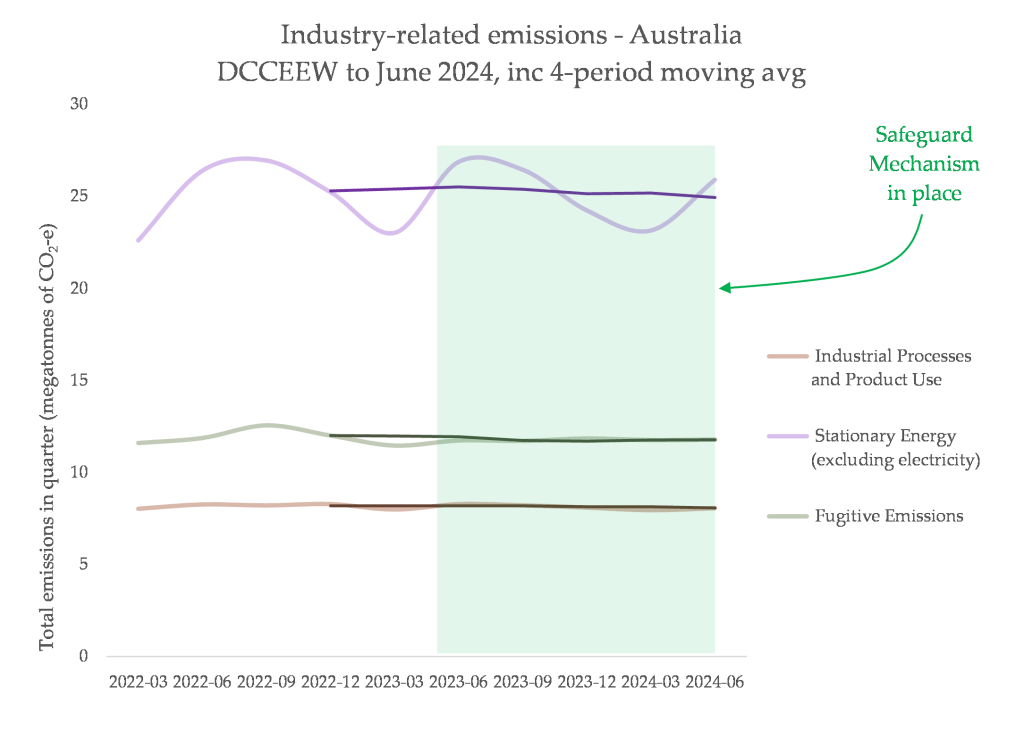
When we look at the sectors that generally contain facilities covered by this weak scheme, there hasn’t been any change in total emissions since the time it became active in July 2023:
The only thing that has changed (and wow, has it changed) is a massive boom in carbon offset purchasing. There has also been a rise in offset prices, meaning carbon offset traders are raking in higher profits because companies aren’t reducing emissions. It is no mystery as to why they lobbied so hard for this scheme.
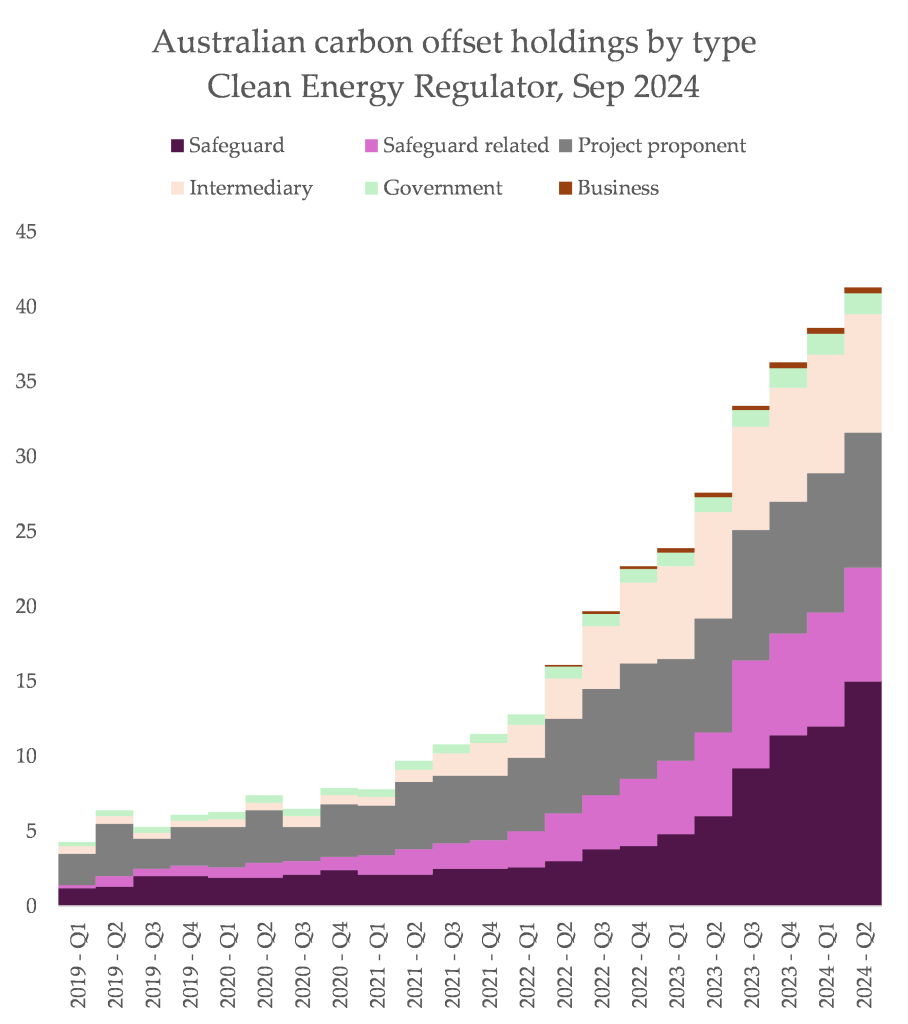
Plibersek draws plenty of justified heat when these coal mines get approved, but Chris Bowen has overseen the fossil mining industry’s core greenwashing ecosystem and doesn’t seem to be criticised for it at all.
Despite a promise to strengthen it once passes, safeguard has been memory-holed, except when it is brought up as a justification for every single new fossil project approval. This screams the obvious: it is there to safeguard fossil fuel industry profits, not the climate. And the more corrosive the climate delay and greenwashing, the bigger the bags of cash the carbon middlemen take home.
Rich enough to stop, too greedy to let go
Oh my GOD, Kentan. Are you saying that Australia should just STOP ITS FOSSIL FUEL EXPORTS OVERNIGHT??
I’m not, no, and it’s super annoying that this strawman keeps emerging. It’s pretty clear what needs to happen: fossil fuel supply needs to be carefully phased out, but in a way that protects against both severe job losses and fuel price shocks. Not easy – but there are already countries beginning to put this into practice.
Colombia is on the verge of releasing a $40 billion investment plan detailing how they’ll replace the export revenue of fossil fuels, two years after they ended new oil and gas exploration, reports Bloomberg. But they need financial help for doing so, and they’ll be lobbying for that at COP29 in a few weeks.
Australia is far richer than Colombia. Wealthy nations like Norway, Australia and the US should be the first to rapidly phase-down fossil extraction industries, and most of all, they should be using their stockpiles of fossil fuel cash to help fund countries like Colombia to phase-down too.
“To leave highly-dependent, poorer countries with enough carbon budget to phase out extraction in a reasonably just manner, less-dependent countries – which face much less challenging prospects – must phase out much more quickly. The least socio-economically dependent countries like Canada, the United States, Norway, Australia, and the UK, must end fossil fuel extraction by the very early 2030s”, found the 2023 ‘Civil Society Equity Review’ report.
That report comes up with a ‘dependence score’, which assesses how reliant each country is on fossil extraction for domestic energy, government revenue and jobs, and weights that against wealth and population (you can read the details in the appendix here). Here’s what Colombia, Norway and Australia look like (a higher score is greater dependence on fossil extraction):
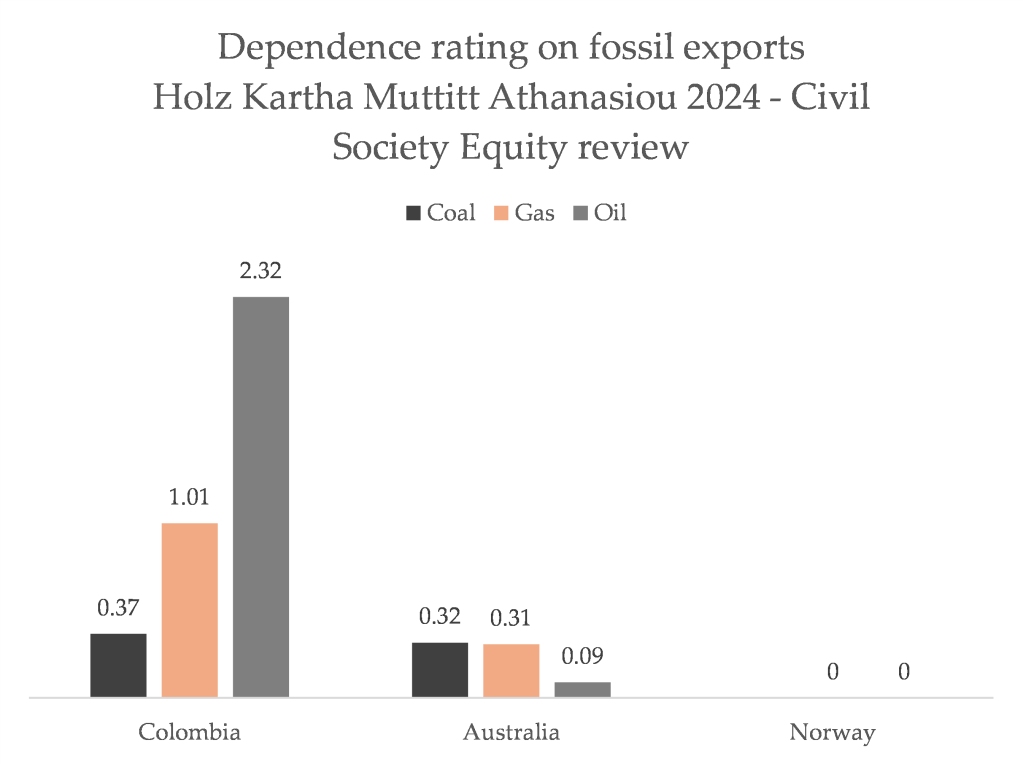
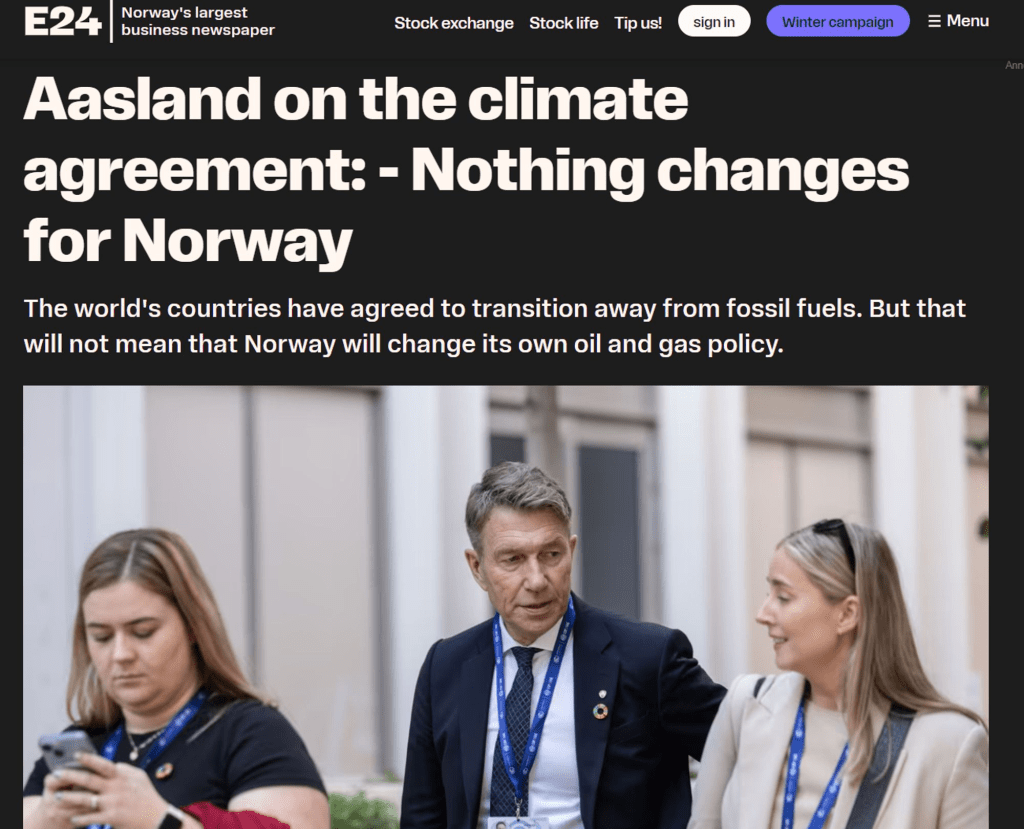
Colombia is one of the countries least-able to afford to phase-out fossil fuels, but it’s doing it anyway. Australia is rich enough to phase-out fossil fuels rapidly, but the government is too greedy and too anxious for that to be even considered a possibility. Norway made itself rich by selling fossil fuels (fun fact: for every $1 we make from this, we cause about $1.80 of irreparable harm to society), but we strolled away from COP28 grinning from ear to ear at having helped get the words ‘transition away from fossil fuels’ in the final text of the agreement. The moment we touched down back home we got right back to aggressively expanding new oil and gas fields.
There is a lot of blame to go around for the overheating of our only home. Those who profit obscenely by being the first step in the movement of carbon from underground to overground will present themselves at the upcoming COP as both blameless for fossil exports and leaders in taking positive action. Australia – and all the other countries in this great global coalition of progressive climate villains – are actively incentivising and subsidising the widening of fossil supply, on the desperate, fingers-crossed, hoping-hard assumption of a catastrophic, deadly failure of the Paris Climate Agreement.
- These are numbers from the latest ‘Resources and Energy Quarterly report’, which I’ve depicted as the cumulative amount of fossil fuels exported by each government since they were elected, and have shown in terms of the amount of climate damage they will do (using a sort of clumsy conversion factors – 2.56 for coal and 2.75 for gas – both numbers very significantly underestimate the real emissions impact of sending fossil fuels overseas, for eg, gas gets leaked out of pipelines and out of tankers ). ↩︎
- I’ve shown most of these charts as a ‘cumulative’ amount of fossil fuel exported (either in megatonnes of the fuel, or megatonnes of carbon dioxide released when burned. For your viewing pleasure, here’s a folder of a few charts showing the same information, but as a quarterly amount, rather than adding up over the quarters. ↩︎
- By the way: the March quarter saw the greatest volume of thermal coal exported in al lof Australia’s history ↩︎
- This hasn’t slowed down the celebrations that centre on individual moments of broken records rather than longer-term trends. ↩︎
- Generous, because it relies on carbon offsets, it’s more like “a policy that allows people to be shot by guns inside the weapons factory, but forces the company to sponsor the local surf life-saving club to the extent that they save a few extra lives” ↩︎
 Ketan Joshi
Thanks Ketan! An excellent analysis. This sentence really stands out: Not only is the Albanese government’s renewable energy growth not offsetting fossil exports, the fossil export industry does about 300 times more climate damage than domestic renewables avoid
LikeLiked by 1 person