
Cancelling Europe’s voltage apocalypse
I’m going to take you on a fun journey, and you know the ride’s going to be sweet because it starts with our mate and friend-of-the-blog Bjorn Lomborg:
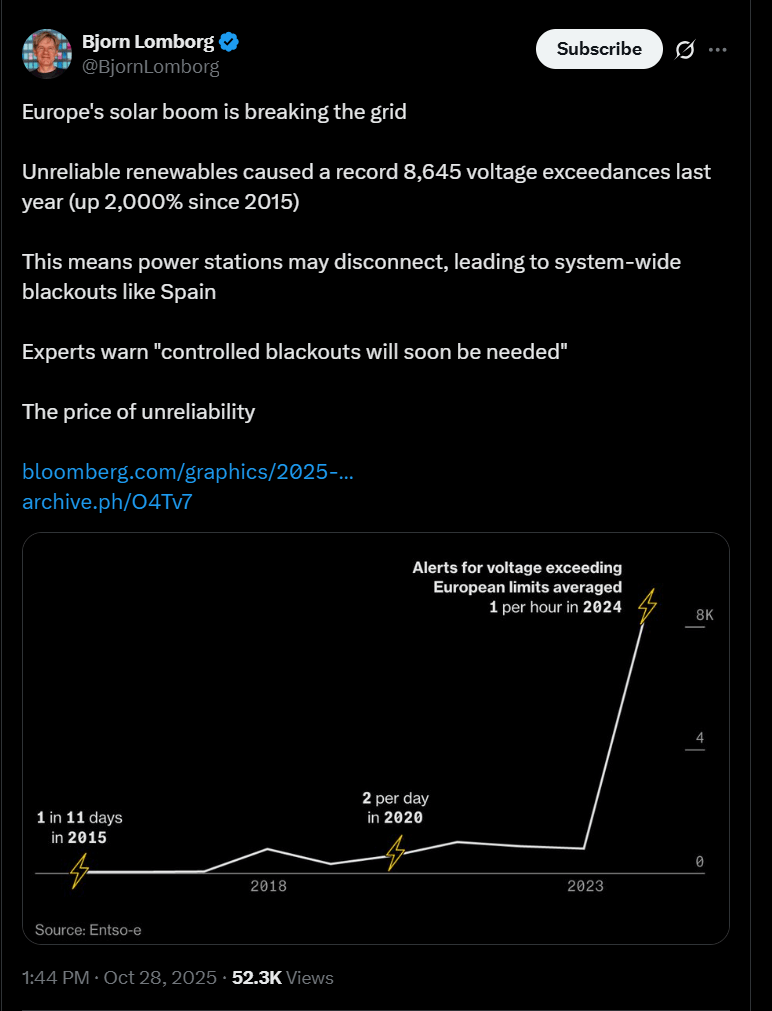
Woah!! Damn……alerts for voltage breaking through European limits have increased 2,000% since 2015, right as solar power has grown in Europe! Case bloody well closed I reckon! Let’s call it a day!
The Bloomberg article Lomborg is linking to (and linking to an unpaywalled version of too; he doesn’t like the journalists enough to want them to be paid for their work) explains that:
"It’s not just Spain, surges in voltage are happening more often in Europe with the rapid addition of renewable power generation. In 2024 there were a record 8,645 instances when voltage rose above allowed European limits. That’s more than a 2,000% increase from 2015, when there were 34 alerts, according to data published by the European Network of Transmission System Operators for Electricity, known as Entso-e. That’s like getting an alert almost every hour, up from fewer than three times a month a decade ago"Bloomberg are reporting on a red-hot issue here. The April 2025 blackout in Spain immediately (as in, literally minutes after it began) become a cudgel against the development of renewable energy, because Spain has a high penetration of solar power generation.
A swathe of commentators and journalists (including Bloomberg’s Javier Blas) immediately and wrongly blamed solar’s lack of “inertia” (the ability of large spinning generators to help stabilise the grid’s heartbeat). But it became clear in further reports this was a massive failure from the large thermal generators to provide voltage control (think blood pressure, rather than heartbeat):
And a few weeks ago, a grid operator statement was wildly misrepresented by Blas and the conservative Wall Street Journal to claim Spain’s voltage fluctuations were so wild the country was moments away from another major blackout:
Okay: you get it. This is a messy issue, and the efforts to keep the madness alive are ongoing. So why is Lomborg triumphantly declaring that solar power in Europe has caused some sort of voltage apocalypse?
Where the number comes from
There is no hyperlink in Bloomberg’s article to find the raw data used for this article. It took some searching using the skeletal remains of Google to find where the numbers are from.
They are from this document: The 2024 Incident Classification Scale Annual Report (ICS). In human language: when something goes wrong in the grid in Europe, it gets given a code that tells you what it is, and how severe it is. Voltage (blood pressure) that’s too high gets you an OV0, OV1, or OV2. On page 12, you can already see a MASSIVE increase in OV0 and OV1 events in 2024, for all the regions covered under the broad ENTSO-E group:
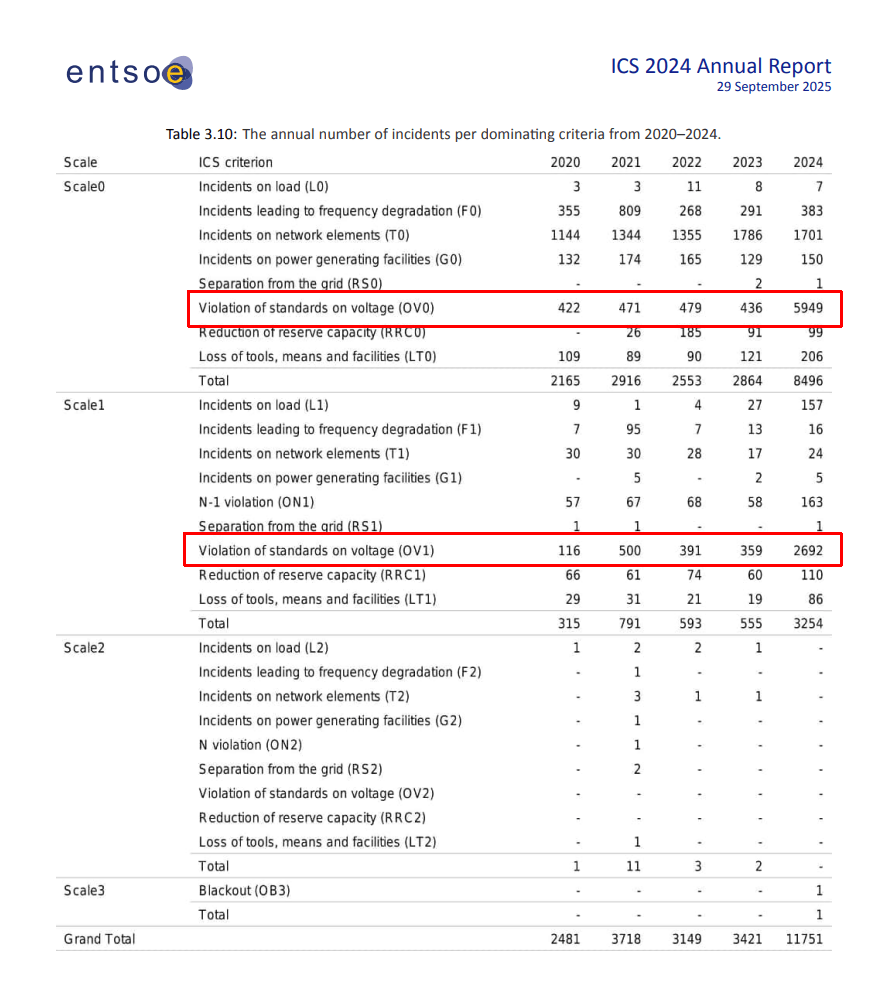
Dig into the detailed view, and things get a little more……complicated.
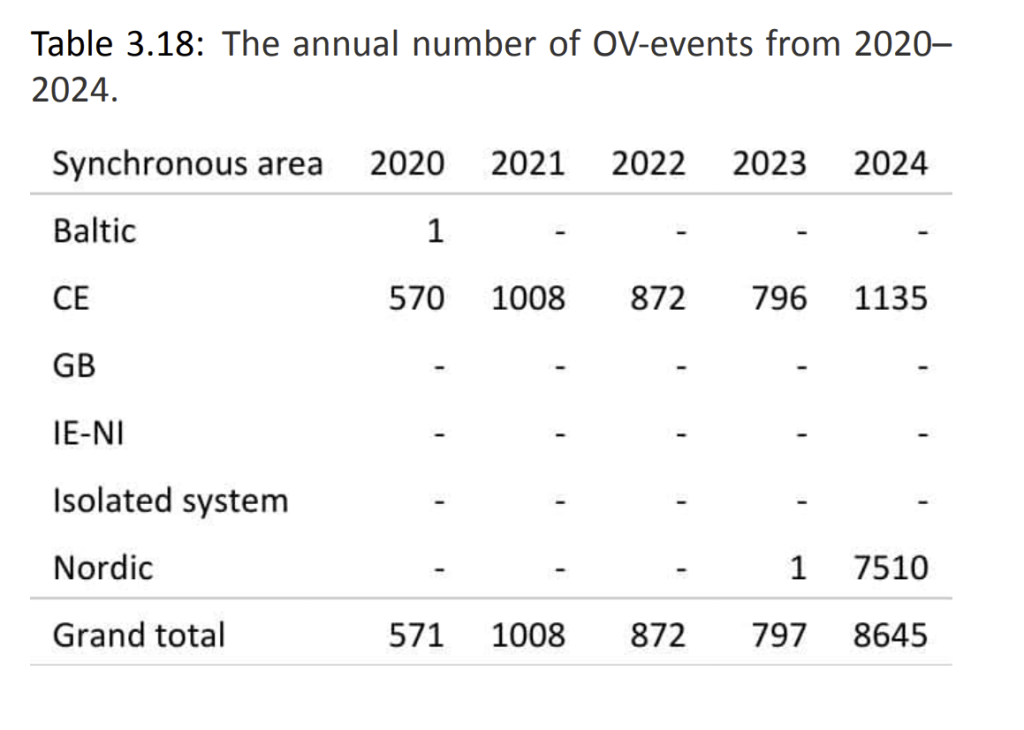
Continental Europe saw a material increase from 2023 to 2024, but it’s not all that different to 2021. Most of the massive number of new voltage violations are from the Nordic area. I live in Oslo, and I have just poked my head out of the window and confirmed that we do not have particularly high penetrations of solar power generation up here. The number of events in the Nordic region was 1 in 2023, and 7,510 in 2024:

So…….er, just so we’re clear here, this is the change in solar power generation proportion in the Nordic region, over the same time period: from 0.3% in 2020 to 1.2% in 2024.

Okay, so solar power didn’t cause a 2,000% increase in voltage issues in the Nordic region. So what did?
"This increase is predominately due to the increased number of reported events by Svenska kraftnät. In addition to observing more voltage violations in the past year, the data collection process was switched from a manual process to an automated data collection process"They go onto state that:
"As can be seen, the number of reported violations of standards on voltage has increased significantly in Sweden. The increase is due to improved IT tools to track and report voltage violations as of 2024. Most voltage deviations occurred in individual stations when there was insufficient reactive power for voltage control during planned outages or low network loading"As you probably guessed a while ago, a 2,000% year-on-year increase in total European voltage alarms is not the result of the natural and honestly pretty gradual growth of solar power generation here in Europe. A Swedish grid operator installed some new software, and it revealed a bunch of hyper-local issues that seem to occur at very specific times, such as during maintenance on grid stuff.
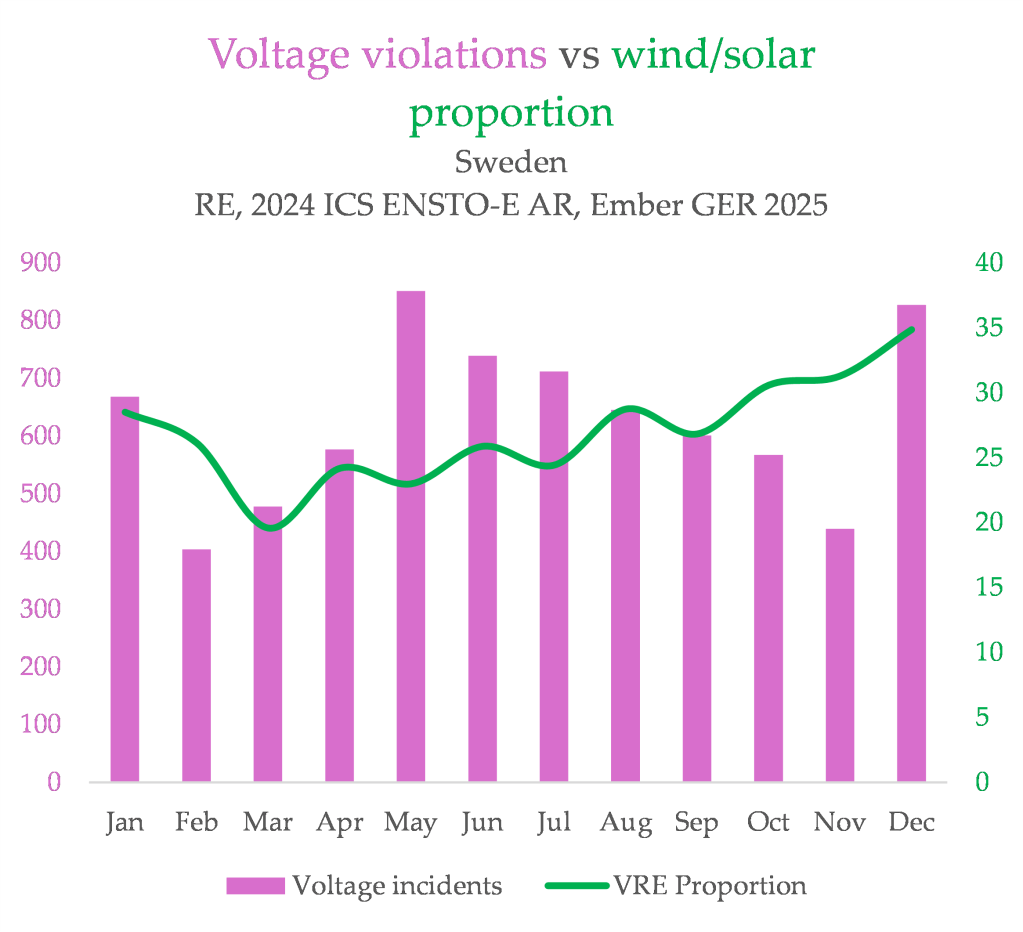
As ENTSO point out, in addition to periods of low power demand, this is partly related to the new operation of wind and solar in the Swedish grid, but with renewables being something that worsens pre-existing issues, rather than causing them1:
"These factors can lead to overvoltages at certain stations when the grid is lightly loaded or when power flow directions change compared to the historical norm. Northward flows emerged during periods of high solar and wind power generation on the continent"This is presumably why the highest wind/solar proportion months in Sweden don’t really correlate to the highest incidents of these voltage alarms, in 2024:
ENTSO also goes on to list 6 actions already being taken by Svenska kraftnät to shore up their voltage control capacity, demonstrating the basic principle that the boring reality of grid management is that engineers just fix stuff and things are usually fine.
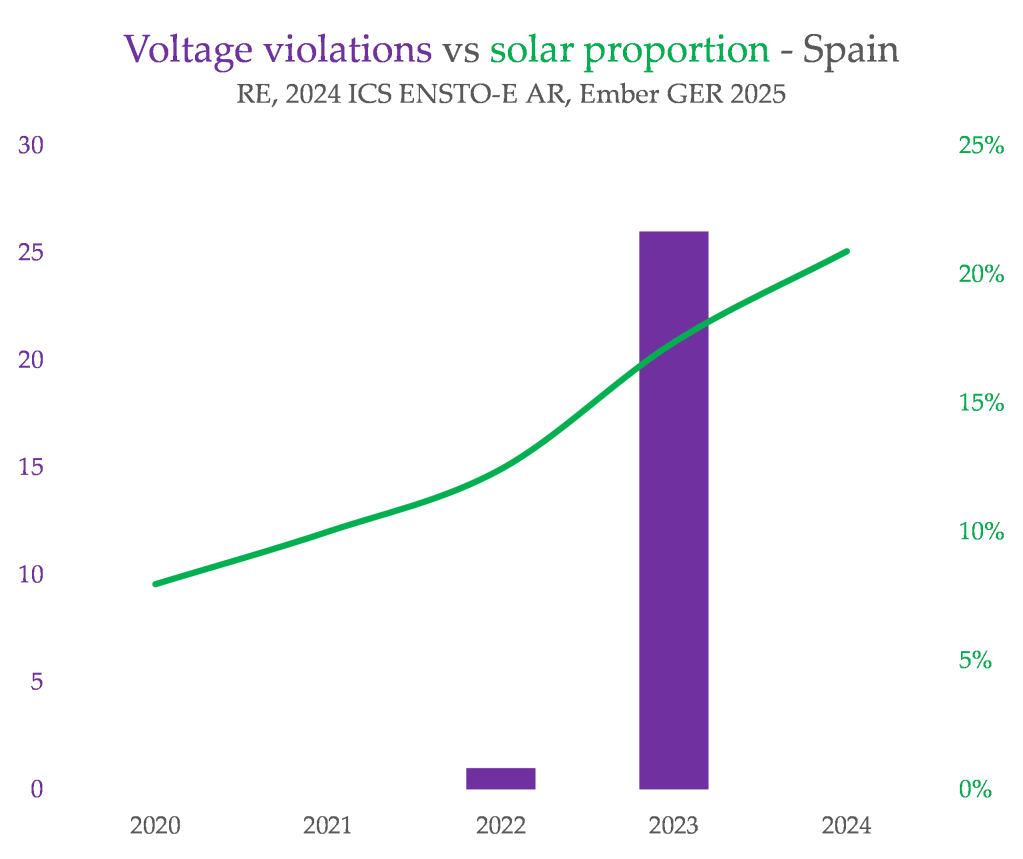
To add insult to injury here, the ICS report also includes the number of over-voltage reports published by Red Eléctrica, Spain’s grid operator. I’ve plotted them below, against the growth of solar power in the region. After a burst of voltage warnings in 2023, there were a flat zero in 2024, as solar’s proportion grew a full whopping five percentage points between those years:
ENTSO-E’s own report into the April blackout in Spain highlights this pretty clearly:
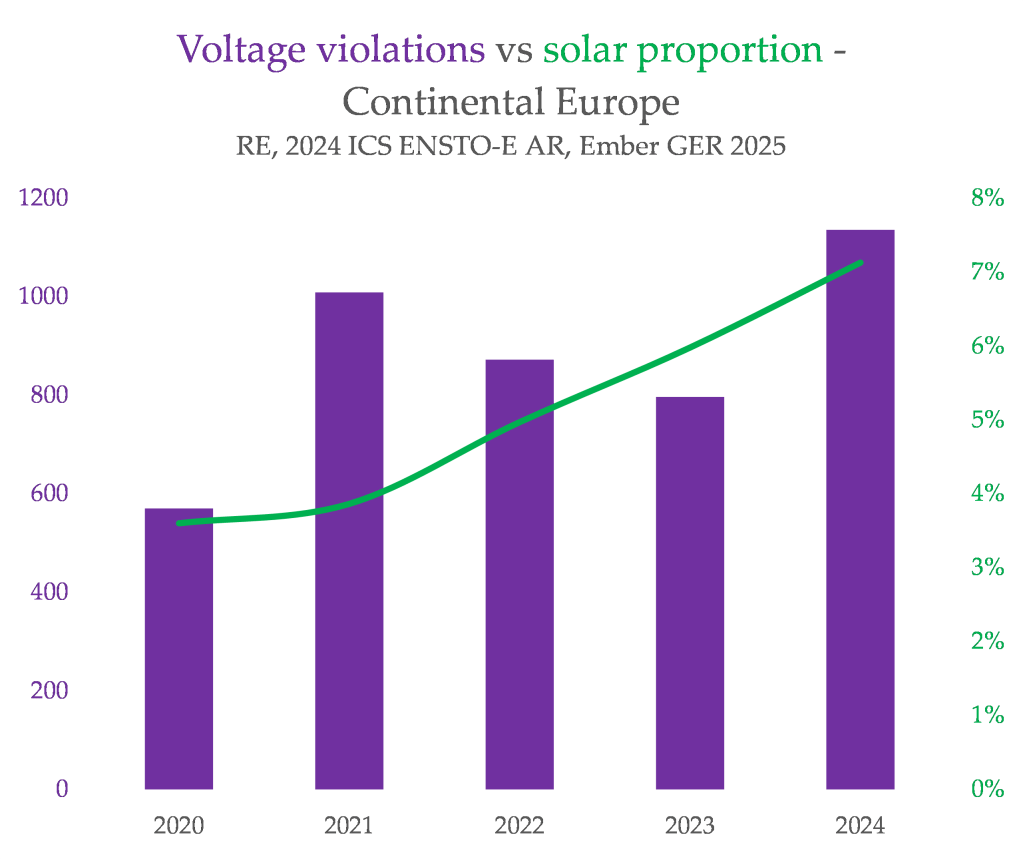
"In terms of deviations from voltage standards reported in the past, RE reported thirteen scale 1 and thirteen scale 0 voltage violations in [2023] and no voltage violations in [2024]. [Portugal's grid operator] REN did not report any voltage violations in 2023 and 2024"You can also look at the growth of solar across continental Europe and see how it is mostly unrelated to solar growth, with the second highest level occurring when solar was at around half what it was in 2024:
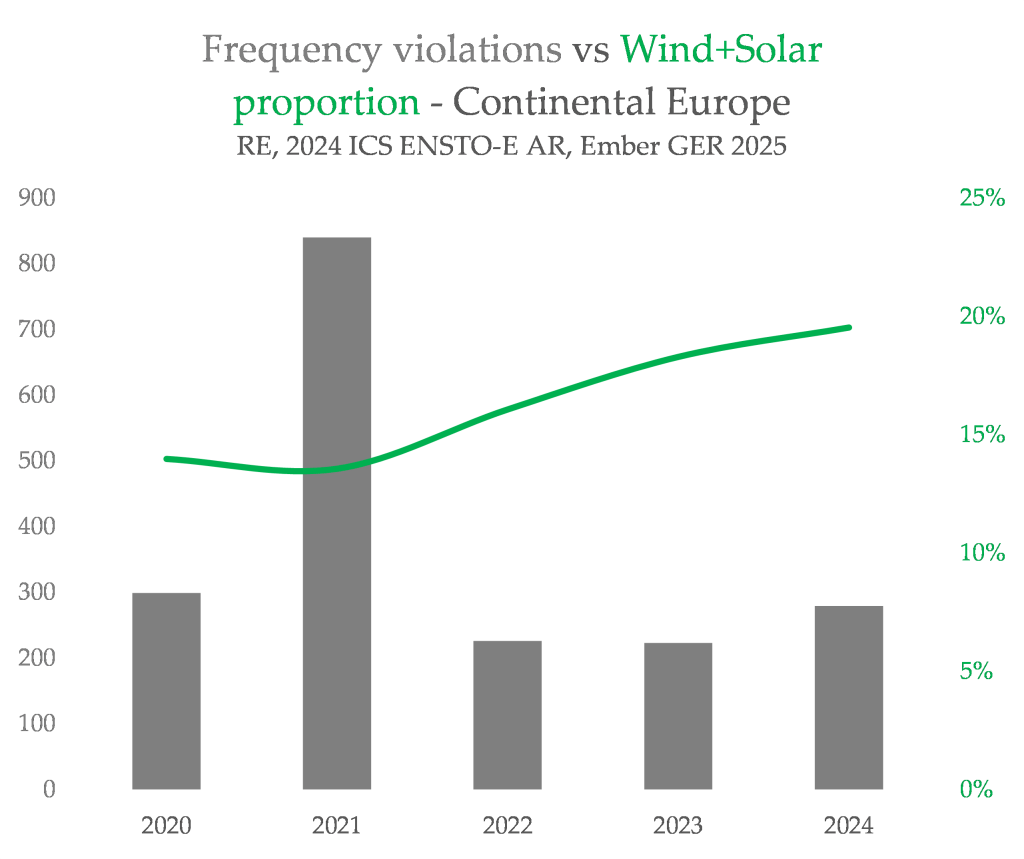
Or, you can look at violations of frequency limits (the ‘heartbeat’ of the grid, and the original failed hypothesis put forward after Spain’s blackout) for continental Europe and both wind and solar:
The 2024 ICS report shows exactly what we would expect it to: the most serious and significant threats to the modern power grid are the atmospheric consequences of burning fossil fuels; namely fires, heatwaves, floods and storms, like this from Spain’s grid operator:
"The reason behind October being the month with the highest number of events is the [storm] DANA that affected Valencia in 2024. The heavy damage that the storm and the floods caused justifies the increased number of events that lasted more than 24 h in 2024 in Spain, as many network elements had to be declared out of service for repairing or replacing them which, in some cases, extended until the beginning of 2025 and compromised complete substations. Most of July incidents are related to fires in [nature]"There are teething problems and integration challenges for wind and solar, but they pale in comparison to what fossil fuels are doing to our power grids. I’m sorry Bjorn Lomborg. You played yourself.
Yes, this is the part where we eat our vegetables. It is still not an easy, smooth or simple thing to integrate a new form of energy technology onto a grid that was designed for 20th century fossil fuel clunkers.
Solar power in particular has a steep up and down curve that brings its own unique challenges for power grids, and there has clearly been a little too much enthusiasm for solar-only models of renewable energy-growth rather than the far more optimised mix of wind and solar.
Aside from the catastrophically misleading voltage warnings graphic, the Bloomberg article itself lays out some serious and real problems that need to manage: namely, the way solar’s high daytime generation can depress wholesale electricity prices, discouraging more renewable energy investment from private companies. It has nice dynamic spiral charts.
And the article also points out that all of this can be managed:
"While retrofitting older systems may be difficult, new solar and battery projects can be equipped with smarter inverter settings to help stabilize grid voltage"But this is exactly what makes all of this so important to get right.
The reality of the integration of wind and solar into power grids is fundamentally just a bunch of engineers figuring stuff out. But the sheer political intensity of the issue means errors in media outlets end up directly feeding the Lomborgian slophoses stationed on feral right-wing social media sites. The roving Sauron-eye of the climate delay machine will find anything from reputable sources that can be put into service defending fossil fuels – how could any self-respecting coal-smoocher resist a voltage chart like that?
Severe mispresentations like the chart above end up making the task of integrating renewables much, much harder.
I have been following the politics, discourse and impacts of blackouts for a long time now, and something very clear is that the ridiculous over-sensitivity that follows a major event like Spain’s lasts for years, not days. Bjorn Lomborg’s posts won’t ‘stop’ the energy transition, but the broad climate delay machine makes the transition harder: displacing more costs onto those least able to bear them, and delaying the elimination of coal and gas by months or years. We shouldn’t be helping them shove a wretched stick in this struggle.
[header – Pexels]
- There is also a really interesting bit about Romania’s renewable energy integration challenges on page 27 ↩︎
 Ketan Joshi