
Texas builds clean power – but it isn’t a climate champion
The eternal drumbeat of terrible climate news creates our desire for something good, and Texas is the kind of contradiction that meets the need.
It is a right-leaning state, heavily invested in the fossil fuel industry. So seeing it deploy eye-watering amounts of wind and solar power has a nice feel to it – climate action that is bipartisan, or even apolitical. It presents the possibility that clean power doesn’t need to be fiercely progressive or left-wing: it can be conservative, right-wing, capitalist, and driven by a free, unregulated market. Forget about the fears and anxieties of right vs left in climate world: it can work without having to bother one’s self with politics.
Texas has indeed built – and continues to build – large amounts of wind and solar, in a relatively deregulated market designed to ease the process of building new infrastructure. A common theme on social and in print is to compare it positively to more left-leaning states like California, and sometimes more explicitly pin Texas’ success on its free market approach compared to California’s stricter conditions:
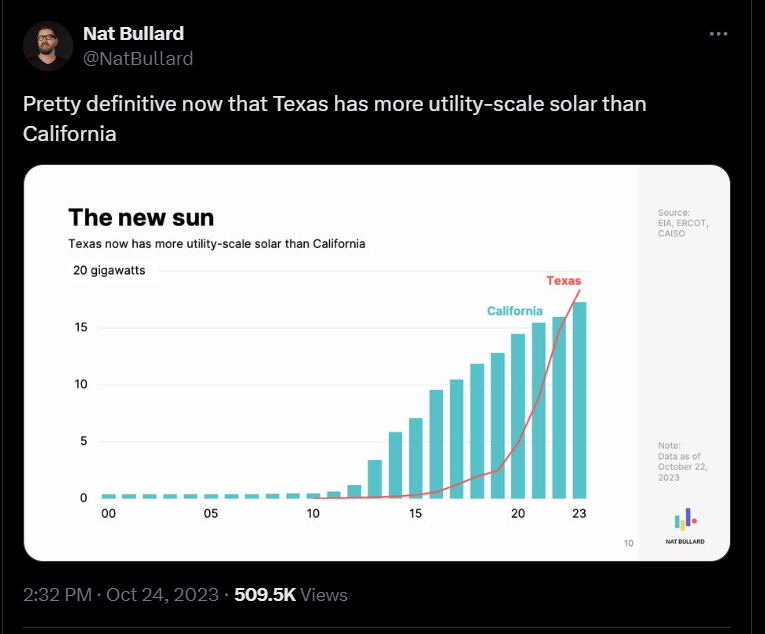
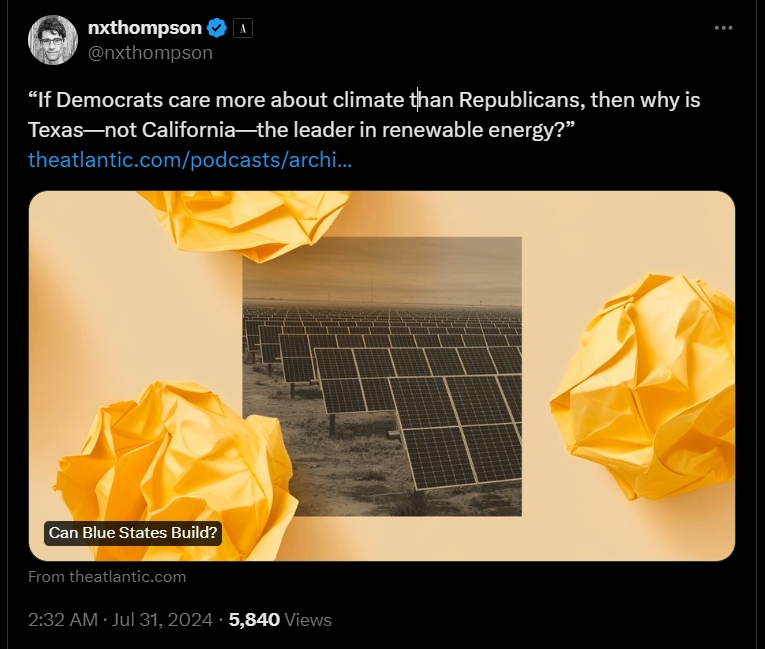
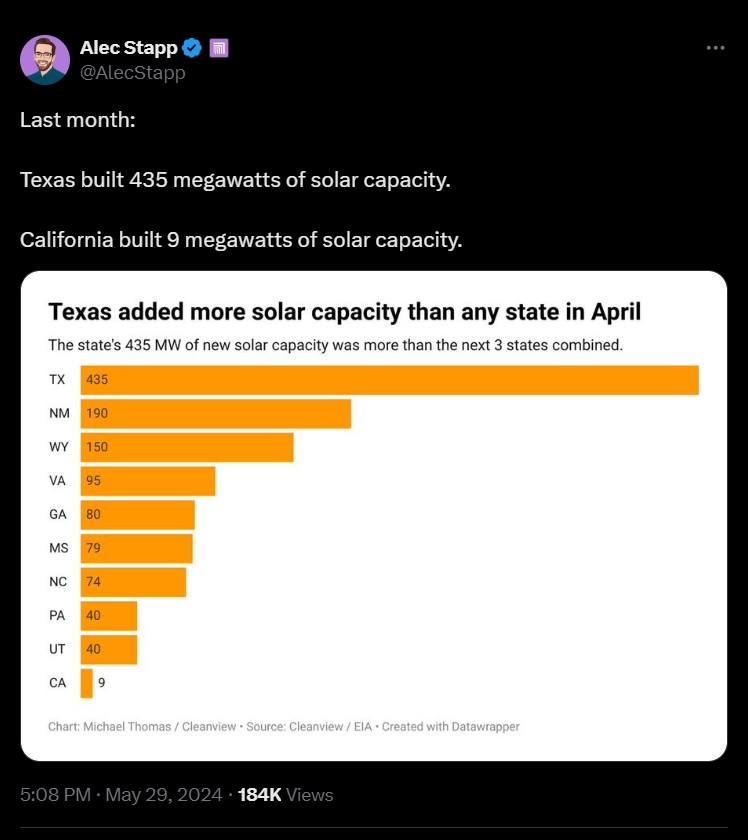
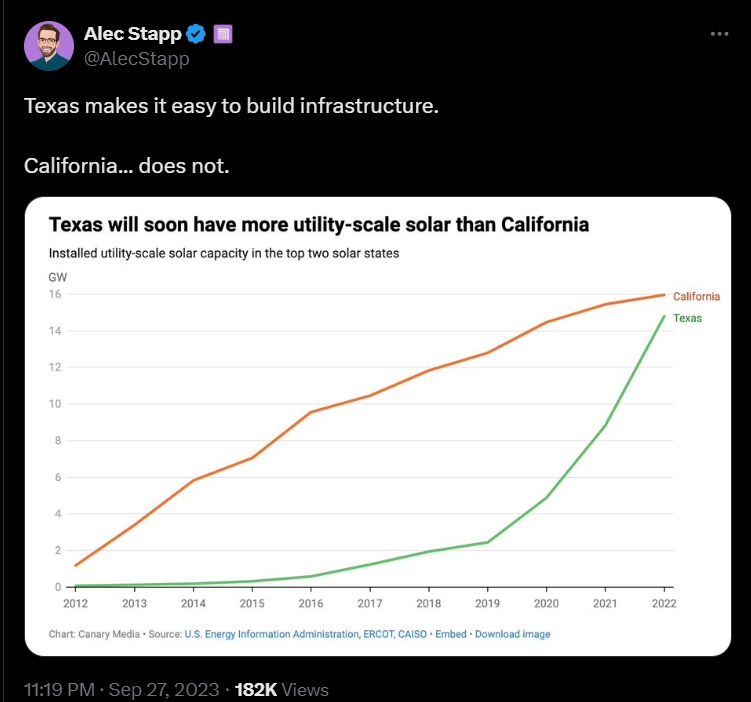
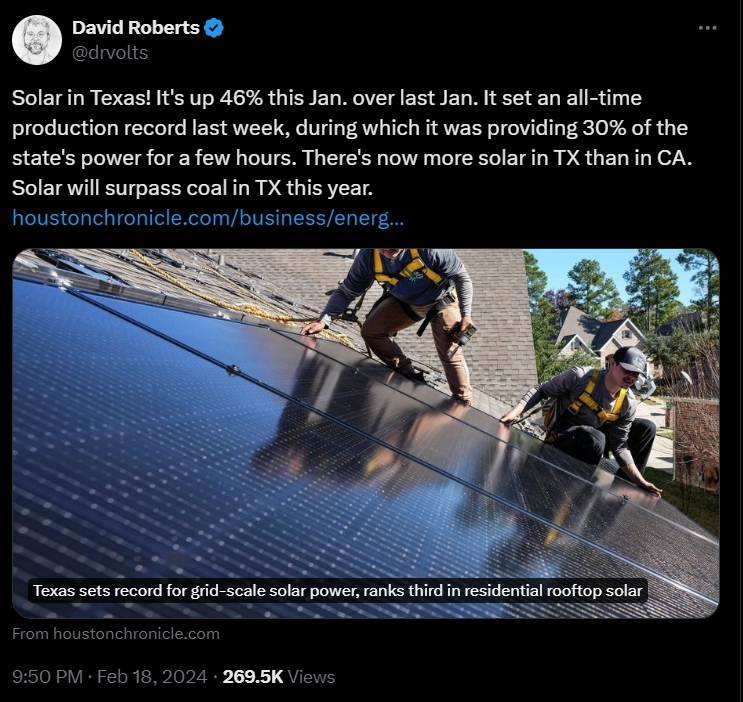
Some screenshots from the pro-Trump website, “X”
As John Burn-Murdoch wrote in the Financial Times:
“The polarised nature of US political discourse can make it seem as if renewables are still a divisive topic. But shift your gaze from cable news to the plains of Texas and a different story is unfolding. For those with skin in the game and an eye for a good investment, clean energy has become a no-brainer”
Burn-Murdoch cites a few data points to back this up – again comparing Texas to California:
- Texas generated more electrical energy from solar than coal for the first time in March 2024
- Texas has higher daily peak solar generation than California
- Texas has a higher installed capacity of solar power than California
- Total clean power generation from non-fossil sources is higher in Texas than California
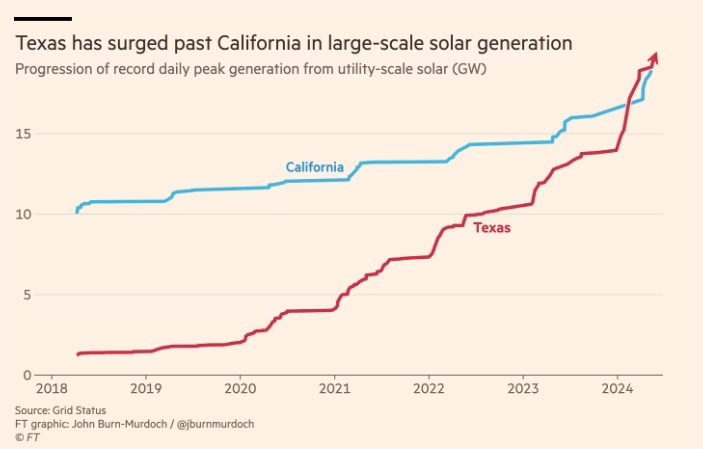
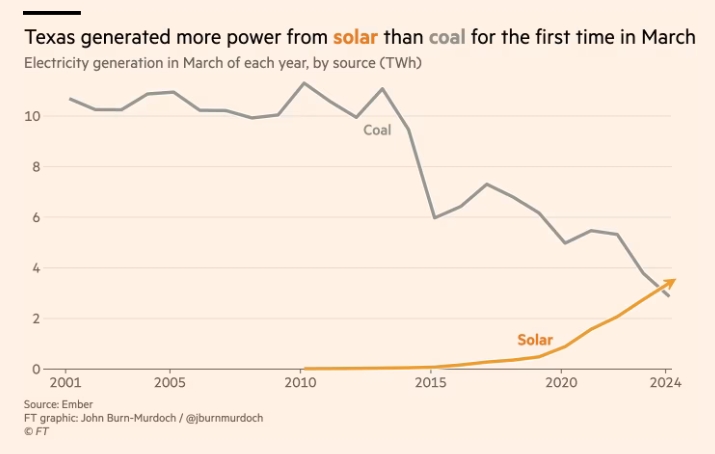
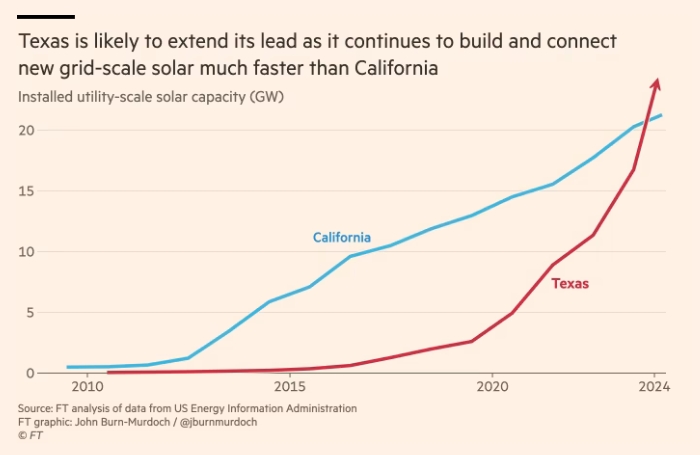
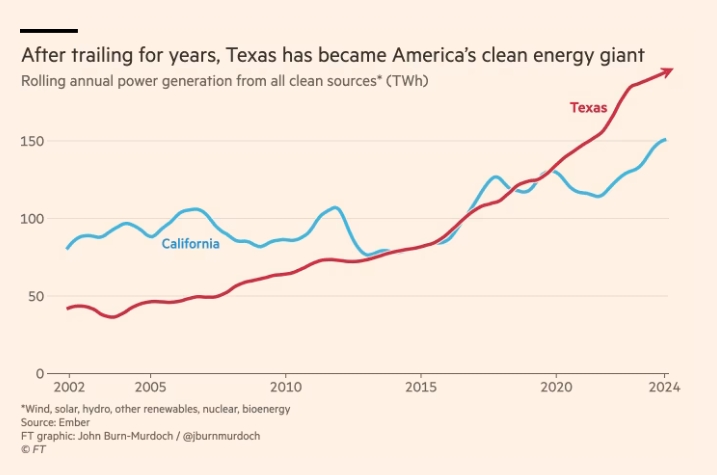
“When the latest batch of solar plants come online, Texas will have added more solar capacity per capita in a single year than any US state and any country in the world”, and hence, Texas has become “America’s clean energy giant”.
Another piece in the Progress Playbook pins Texas’s success very specifically on its deregulated market, compared to California: “while the likes of California have policies in place to decarbonise their power grids, Texas does not. Instead, the state relies on market forces”.
“Texas has become the nation’s renewable-energy powerhouse. This didn’t happen because Texas Republicans are deeply committed to fighting climate change; it happened because, in Texas, infrastructure projects are easier to build—something that can’t be said for a lot of the country, including in states led by Democrats who claim to prioritize the climate crisis”, wrote Jerusalem Demsas in The Atlantic, as an intro to a podcast interview with energy expert Jesse Jenkins. “We’re here to talk about why it is that Texas has been better than California at building renewable energy”. Demsas goes on to say (supported by Jenkins) that in Texas, “I don’t think that they care more about renewables than the people in California do. It feels like in Texas, they just let things happen”.
Demsas and Jenkins link this to a live debate in the US centring around the aggressive deregulation of energy development, purportedly in the name of accelerating climate action, relating to ‘permitting reform’ to cut red tape around approvals for large renewables and power lines – but also for major multi-decade fossil fuel infrastructure projects. Jenkins says: “It’s probably true that people in California care more about wind and solar than they do in Texas. It’s just that the state infrastructure and culture are not oriented around the idea that we need to build that”.
It is a live debate. A new permitting reform bill in the US has passed through an energy committee but has to pass more major hurdles to become reality. There is a good chance it’s a poison pill where claimed progress on clean power is being handcuffed to serious ‘progress’ on worsening fossil fuel infrastructure and production. “What is being built into this bill is not next year’s emissions. It’s thirty years of emissions”, Johanna Bozuwa, Executive Director of the Climate Community Project, told Heatmap.
In this context, the question of whether deregulation has made Texas in a global leader in climate action matters quite a lot. So let’s dig deeper.
The reality of climate action in Texas’ power grid
For the most part, none of these numbers are wrong. If you look at this issue purely through the sheer absolute volumes of renewable energy being added, Texas really is doing pretty damn well. Many of the graphics and numbers exclude California’s considerable rooftop solar generation, because it’s not metered and tough to estimate – but let’s grant them that, for now1.
The first most obvious point to make here is very simply that Texas’ power demand is massive. It has been the largest in the US for a while, and it has risen badly in the past few years due to increased cooling, Bitcoin mines, data centres and fossil fuel extraction power demand2
So when you take any energy supply in Texas in absolute terms, it’s going to look way bigger than the other large states – that’s true for both fossil fuels and for clean generation:
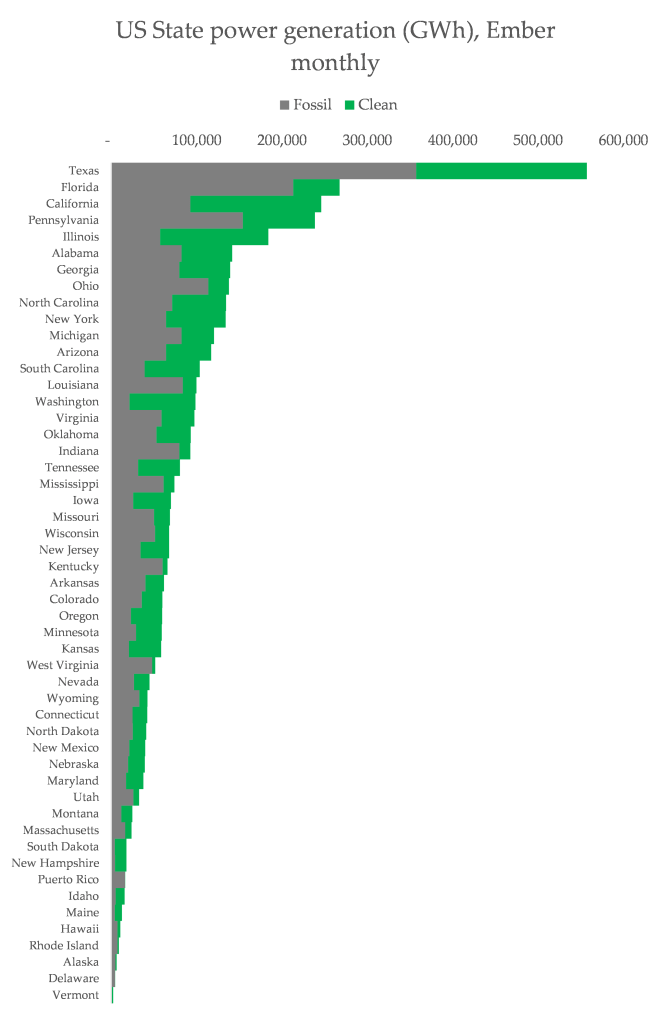
What this means is that when you look at utility-scale solar as a proportion of total generation within the state rather than absolute figures, an incredibly different picture emerges:
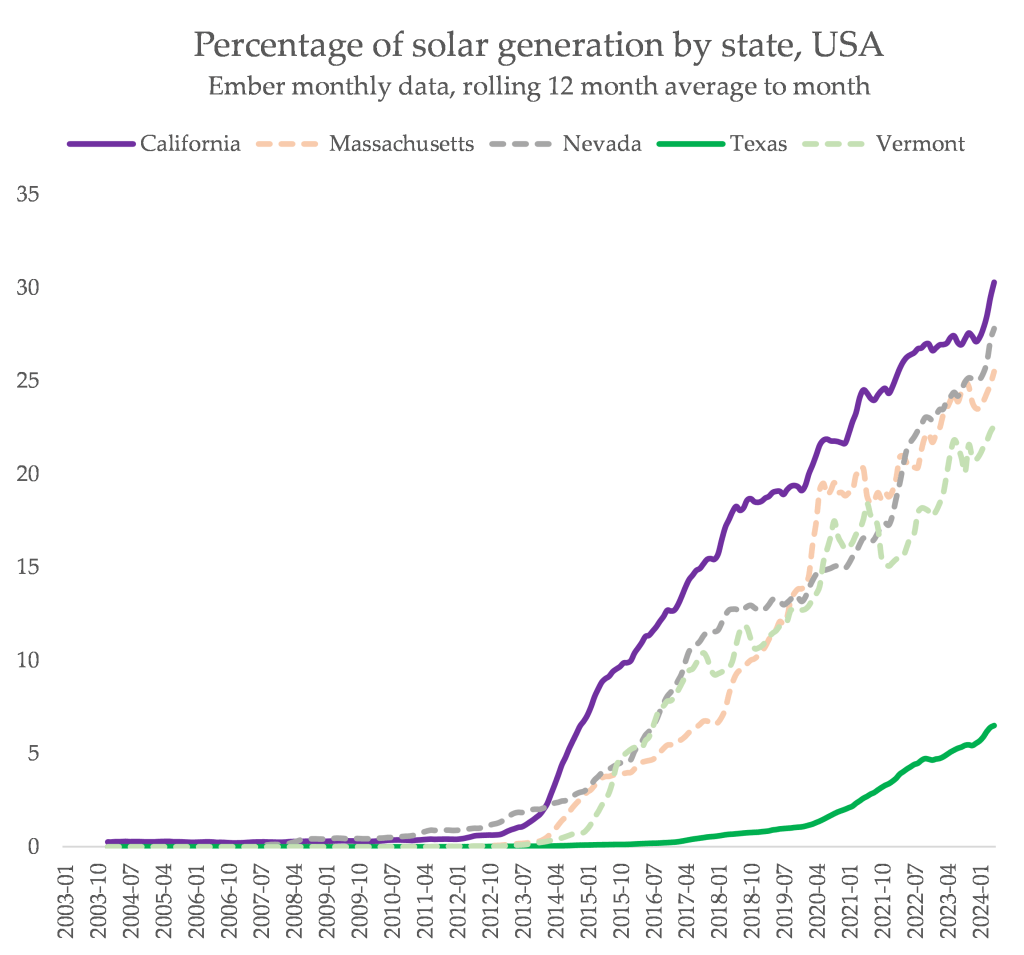
Things get even starker when you normalise each of these states to the point at which they passed the 1% solar proportion, shown below relative to the number of months before and after that moment:

In the time it has taken Texas to hit a measly 7% utility-scale solar proportion, California was more than 15%.
Texas has also been a hotbed of wind power development, and it has operational nuclear power stations, too. But the story doesn’t change much when you look at all clean power.
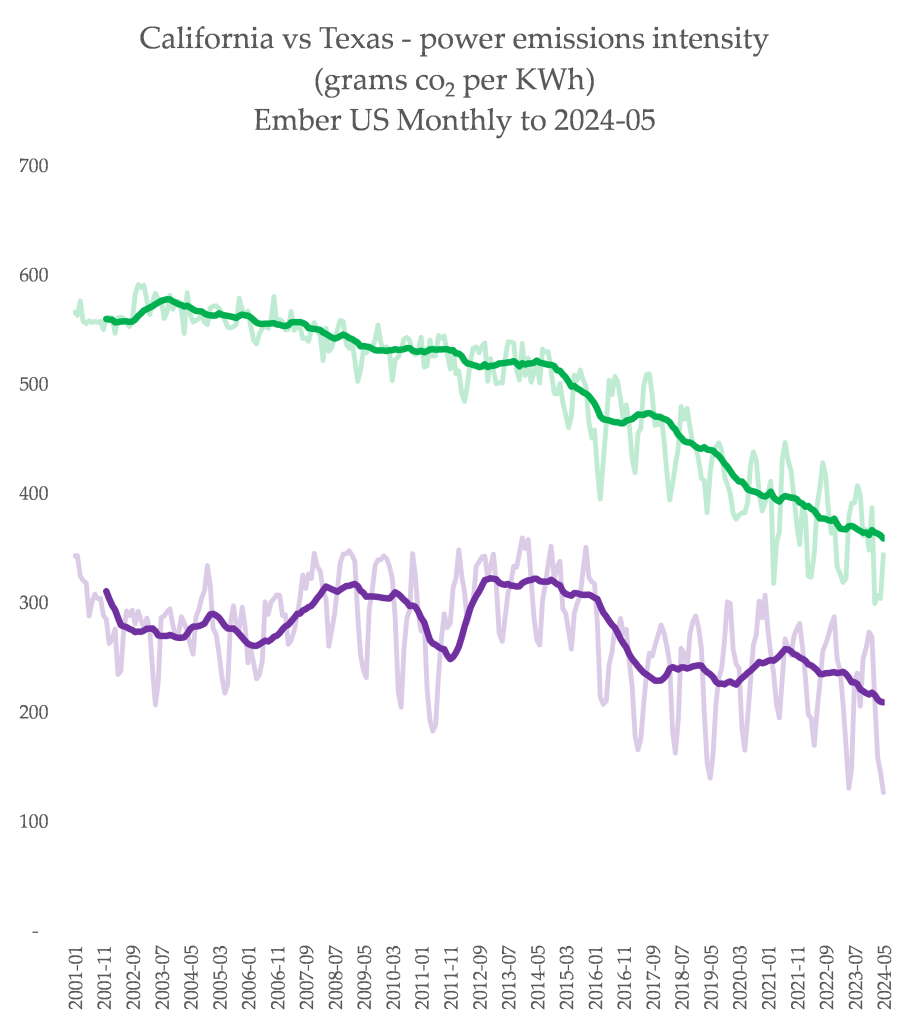
When you compare the total proportion of clean generation (again – utility-scale only, so this is underestimating California’s solar and favouring Texas), you can see very clearly that the claim “California has begun to lag behind Texas”, as Demsas claims in The Atlantic, is absurd. Texas has never had a single month with a higher proportion of clean power generation – or a lower emissions intensity – than California:
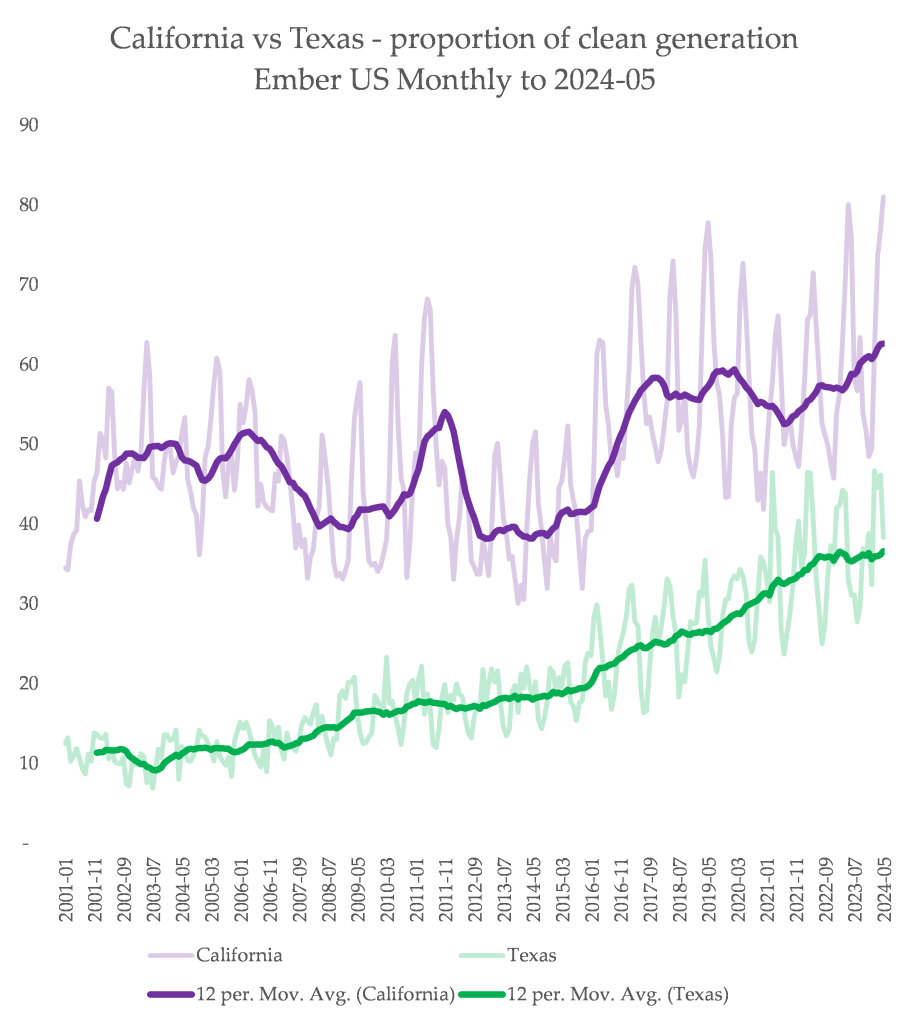
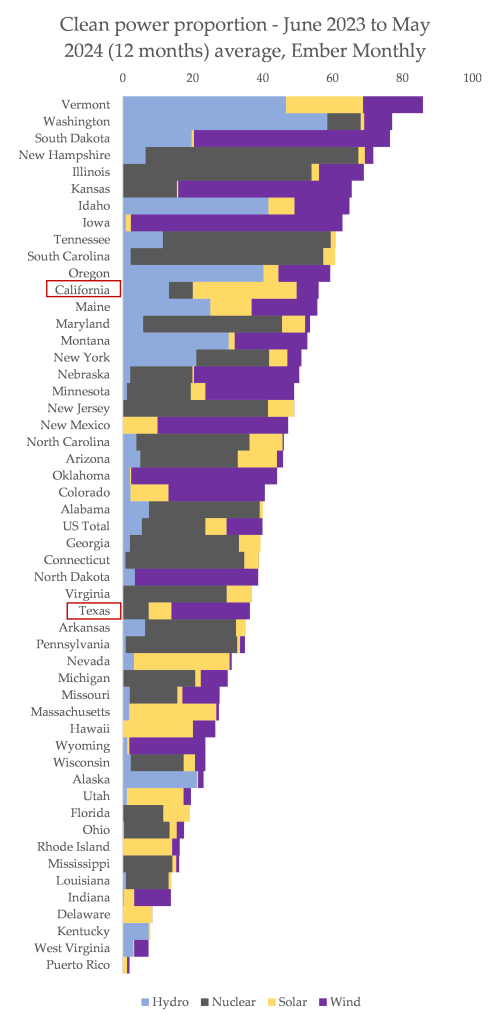
In fact, Texas has a lower clean power proportion than not just California, but the average clean proportion in power grids across the United States:
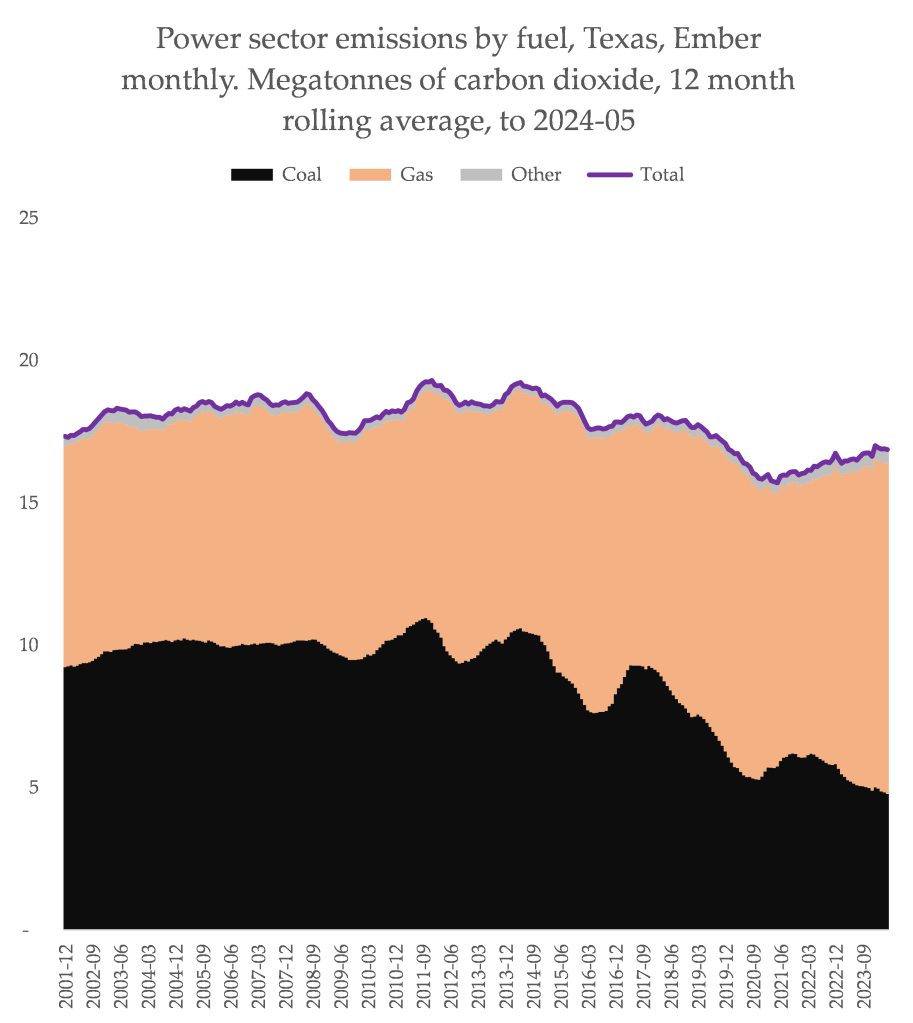
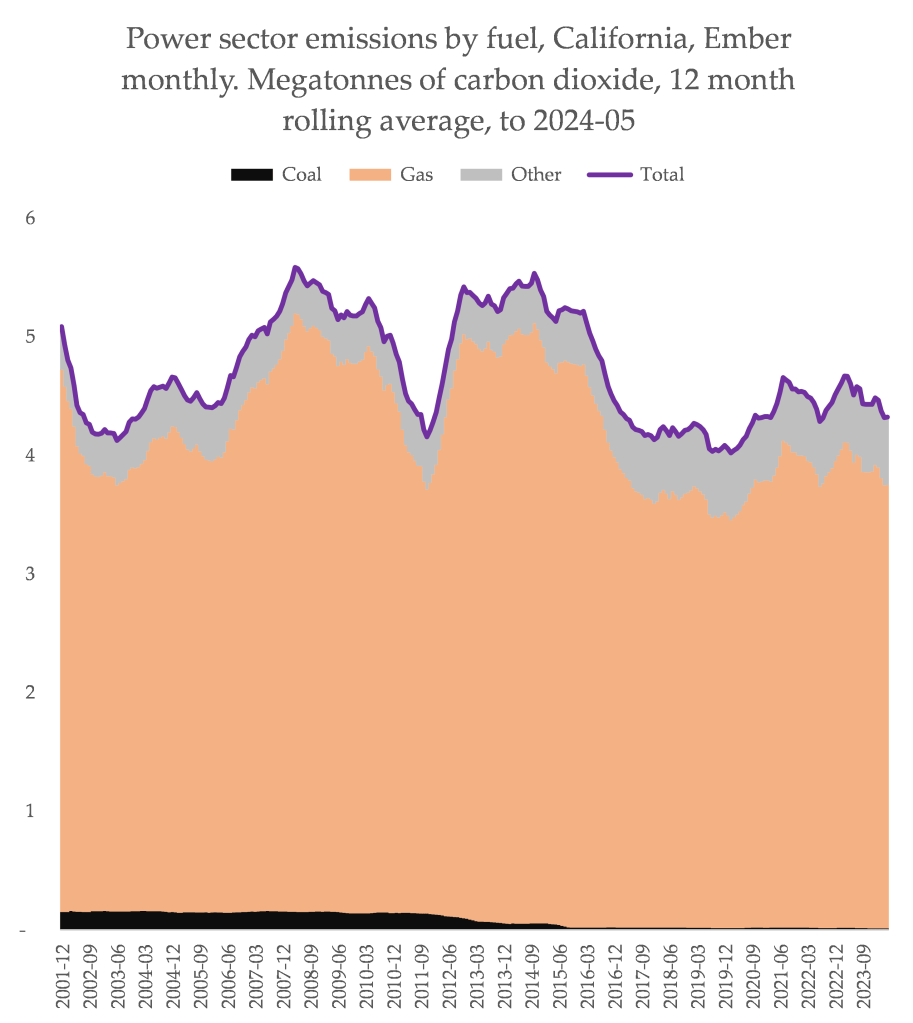
It is also worth noting that – thanks partly to new clean power meeting rising power demand instead of cutting down hard into fossil gas – both California and Texas are seeing rising emissions. But Texas’ emissions have been rising fast, and consistently for verging on four years now.
Despite rapid clean energy growth, when it comes to being a climate champion Texas is a disaster:
What’s your goal here?
If Texas’ deregulation were a clever conservative shortcut to rapid climate action, the power sector should be seeing plummeting greenhouse gas emissions. Thanks to the still-widespread assumption that ‘more clean energy = more climate action’, Texas still gets regularly presented as if, implicitly, they are plummeting.
Looking narrowly at Texas’ solar, or its wind, makes it look like the best climate state in the US. When you look at the whole picture – its rising fossil fuel power output and its rising total demand – you see that it is an incredible example of how a total absence of any government intervention to reduce emissions results in…well, rising emissions.
It is worth noting that California’s emissions are not exactly plummeting, either. Like Texas, the reasons are seemingly various and complicated. But there is really no argument that the narrative Texas is “beating” California in the power sector climate stakes is amazingly wrong. And this real-world example should serve as a stark reminder – during a critical climate policy debate – that right-wing deregulation does not guarantee climate success.
Header image: David Hoffman, Flickr / Creative Commons
- Jeff Davies at EnerWrap estimates Texas will catch up with California in absolute installed solar capacity – including rooftop – around April 2026. But that means Texas will still then have a smaller proportion of solar generation of total demand – probably forever, if it maintains its wild energy hunger ↩︎
- This is also why “per capita” numbers tend to favour Texas: California has a higher population than Texas, so per-capita anything will look huge for Texas and smaller for California. That isn’t down to Texas over-performing – that’s down it being one of the most stunningly energy-hungry places on the planet – often for grim reasons like fossil fuel extraction or skeezy Bitcoin stuff. ↩︎
 Ketan Joshi
Thank you for this clear analysis.
LikeLike
Important data but the author is preoccupied like most media with “who’s best”, motivation, etc. The critical point is that excessive regulations obviously inhibit development. It’s a major reason why it takes many years to gain federal permits for any major infrastructure and we don’t even have plans for expanding electrical grids from the wind energy Midwest to the populated but alternative energy poor East
LikeLike
Did you add in the power that CA purchases from surrounding states and the sources of that power? I’ve read that some of the purchased power in CA is from coal plants in other states. I’m from CA.
LikeLike
Read like someone that started from a Texas hating perspective, then back filled the necessary data to justify the hate. Texas weather is exceedingly more extreme than California. Texas industry is a major engine of the US, so try to show just a wee bit of respect.
LikeLike