Planet of the humans: A reheated mess of lazy, old myths
This is the the first in a series on Planet of the Humans. The other posts are here:
Post 2 – on where we’re at in 2020, with climate and clean tech
Post 3 – on the ‘bigger picture’ of the film, and why the film is so harmful
The film ‘Planet of the Humans’ opens with the director, Jeff Gibbs, operating a fossil-fuelled combustion engine vehicle, on a road full of combustion engine vehicles, followed up with some footage taken from the International Space Station (fossil fuelled rockets put that in space).
This is not a documentary about the environmental damage that had to occur for Gibbs to go on his drive – it is not mentioned. Nor is it about the harm from fossil fuels.

It is about why renewable energy is bad. I used to work in the renewable energy industry – first, with wind farms and later in research, government agencies and advocacy groups. So it was hard to resist both watching and reviewing this one, considering it launched on ‘Earth Day’, and it has been widely promoted.
Not only is the documentary bad, it’s old bad. Please join me on this journey back in time. It won’t be fun, but I’m glad you’re here with me.
All of the stuff in this documentary is ancient
It is clear that Gibbs has been trying to make this documentary for a long, long time.
“He is currently working on a film about the state of the planet and the fate of humanity”, read his bio, in 2012. It is clear, digging into these early posts, that he very passionately loathes the burning of trees to generate energy – a wildly controversial and genuinely problematic thing, for sure.
But as early as 2010, Gibbs was posting HuffPost blogs extending that into wind and solar, too.
This one, for instance, repeats a bog-standard list of anti-wind and anti-solar memes that, back in 2010, were fashionable among climate deniers. The ‘wind and solar are too intermittent’ meme, for instance, is a great hallmark of that era. “How much variable energy can a grid accept? Around ten percent, twenty percent tops it appears”, he wrote back then. I’d include examples of grids with higher percentages operating without a hitch today, but it feels almost cruel.
The extreme oldness of this documentary stands out. In one instance, he tours a solar farm in Lansing, Michigan, in which a bemused official states that a large farm can only power ten homes in a year.
It is the Cedar Street Solar Array, a 150 kilowatt 824 (that’s small) panel farm in downtown Lansing. Guess when that bad boy was built? 2008. Twelve years ago – an absolute eternity, in solar development years.
As PV Magazine writes, “The film reports on a solar installation in Michigan with PV panels rated at “just under 8 percent” conversion efficiency. It’s difficult to identify the brand of panel in the film (Abound?) — but that efficiency is from another solar era”. Efficiency gains in solar have been so rapid that by leaving the dates off his footage he is very actively deceiving the audience. The site generates 64-64 MWh a year, according to the owner – a more recent installation in the same area generates around 436. The footage really is from another era. It’s like doing a documentary on the uselessness of mobile phones but only examining the Motorola Ultrasleek.
Later, they visit the Solar Energy Generating System (SEGS) solar farm, only to feign sadness and shock when they discover it’s been removed, leaving a dusty field of sand. In the desert. “Then Ozzie and I discovered that the giant solar arrays had been razed to the ground”, he moans. “It suddenly dawned on me what we were looking at. A solar dead zone”.
Which is a weird one, because the site they were visiting, SEGS-1 and SEGS-2 site in Daggett, was midway through being replaced with upgraded solar PV, which generates significantly more electricity, is cheaper, has no site emissions and has no water usage, compared to the 1984 technology.


Sunray 2 and 3 are now generating electricity – significantly more than the old site. 97,631 megawatt hours in 2018. You could run a toaster for 9,288 years, by my calculations. There is a 650 megawatt expansion planned – to be built over existing human-impacted land.
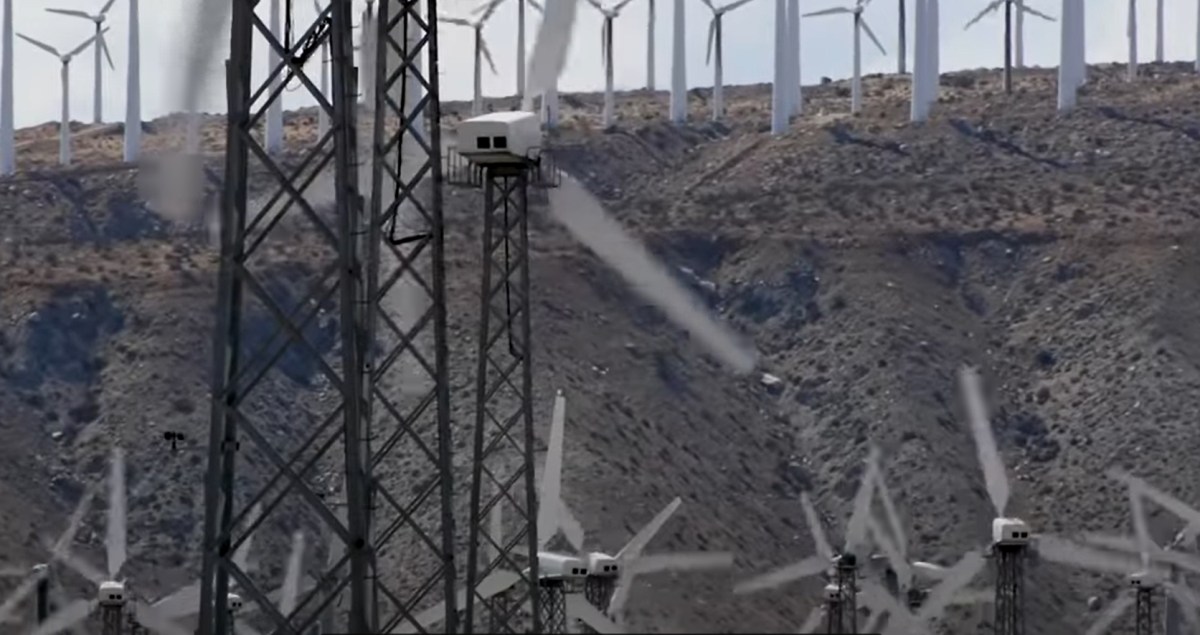
In a red flag for any veteran of the wind farm debate, Gibbs then uses footage of a collection of old wind turbines – rusted, gross and horrible – to illustrate the short life and lasting damage of these huge spiky bastards.

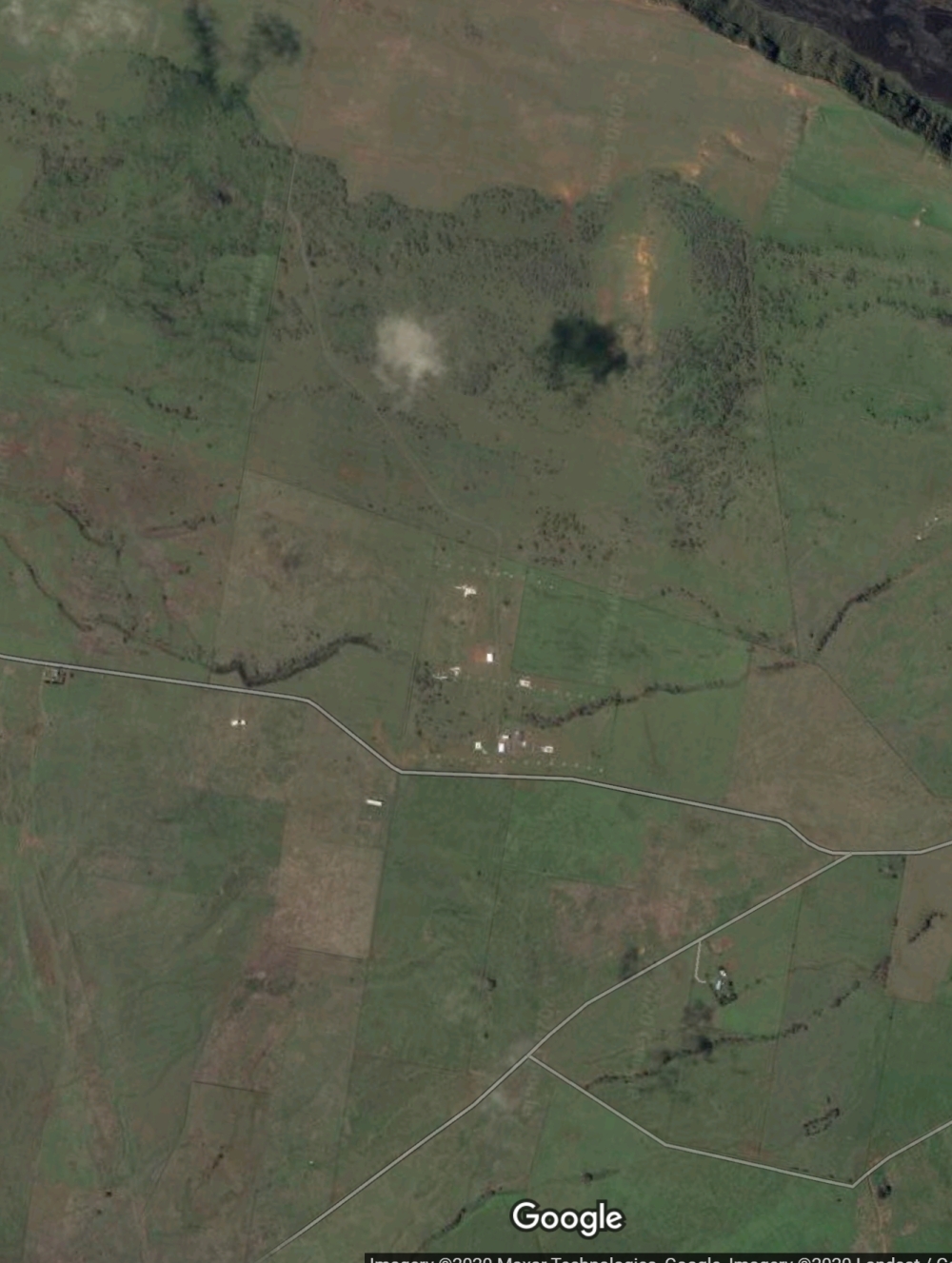
If you’re familiar with the network of anti-wind farm groups, you’ll recognise that they’re old machines from South Point on Big Island, Hawaii. They were removed in 2012, by the owner of the facility. All that is left now are small hexagonal pads on farmland used by the cattle that roam it:
“Why for most of my life, have I fallen for the illusion that green energy would save us?” It sounds like he’s saying this in 2020, but he is saying it well in the past. Gibbs was posting anti-wind memes roughly 23 full epidemics ago.
Nothing in this is new. With regards to its wind and solar parts, it smacks of 2010s era climate change denial, in which renewables were seen by detractors as expensive, wasteful, low-capacity, heavily corporatised and destined to fail. Things are different in 2020, but the director isn’t. He doesn’t need to be.
Even the ideas are old
Putting aside the sites they visit and the footage they use, there are some ideas in this documentary that are well worn and highly recognisable memes from the 2009 – 2013 climate denial wonder years.
You can tell when someone’s knowledge of this has formed solely from doing a Google search for “solar panels bad don’t like”, and it really shows in this film.
Early on in the documentary, Gibbs has an exchange with an anti-wind farm protester about coal-fired power:
Protester: You need to have a fossil fuel power plant backing it up and idling 100% of the time, because if you cycle up or cycle down as the demand on the wind comes through, you actually generate a bigger carbon footprint if you ran it straight”
Gibbs: Do you ever go to things where they just go “Oh, that’s not true, it doesn’t matter we’re going to have a smart grid”?
Protester: Doesn’t make any difference, they still gotta– they’re using it. You gotta have it idling. Because, let’s just say the wind stopped right now. Just stopped for an hour. You’ve got to have that power
This extremely silly concept – that coal-fired power stations run at 100% capacity all the time regardless of how much power they output – is so old it hurts my brain. In fact, it was big in 2012, when I came across it in Australian media. It’s wrong. If the power plant generates less electricity, it uses less coal. Gibbs is putting this eight-year-old meme in the microwave and serving it up in for his audience.
Later, he presents the work of a researcher named Richard York, who claims that the addition of renewable energy has no impact on fossil fuel output. I can’t access the paper, which is from – you guessed it – 2012, but the premise is mind-numbingly silly.
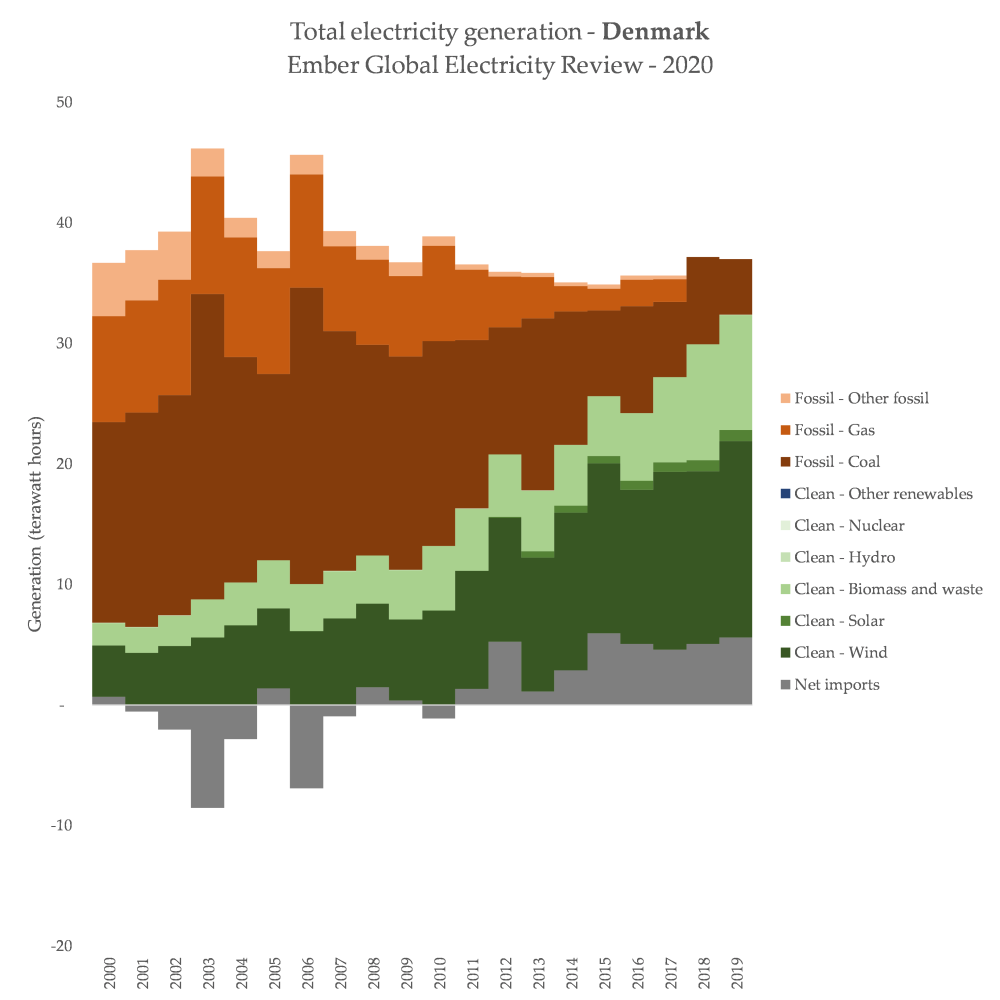
Electric grids match supply and demand at all times. Energy generated from one new source has to replace energy generated from an existing source – the grid would collapse, if it didn’t. That is why South Australia’s grid looks like this:

And Denmark looks like this:
Things start to get into proper, outright, anti-vax / climate denier grade misinformation when producer Ozzie Zehner comes in.
“One of the most dangerous things right now is the illusion that alternative technologies like solar and wind are somehow different from fossil fuels”, he tells Gibbs. “You use more fossil fuels to do this than you’re getting benefit from it. You would have been better off just burning fossil fuels in the first place, instead of playing pretend” .
It is, in fact, possible to scientifically examine the emissions associated with making, transporting and erecting renewable energy, and compare it to the emissions saved by using it. There are just so many studies on this, but here’s the Breakthrough Institute’s Zeke Hausfather:
It’s important to be really clear about this: Zehner’s remarks in this film are toxic misinformation, on par with the worst climate change deniers. No matter which way you look at it, there is no chance that these projects lead to a net increase in emissions.
Gibbs attends a solar conference – again in some non-specific year – and is told by a bunch of obviously well-meaning and slightly baffled young renewable energy experts (literally the only young, diverse people in the film) that battery storage is a way of managing intermittency.
“When I looked up how much battery storage there is, it was less than one-tenth of one percent of what’s needed”, he says, presenting a pie chart (augh) of IEA data with a minuscule slice from batteries. But grid scale of batteries doesn’t need massive capacities to be functionally useful for managing the integration of renewables – so it’s a deeply misleading chart.
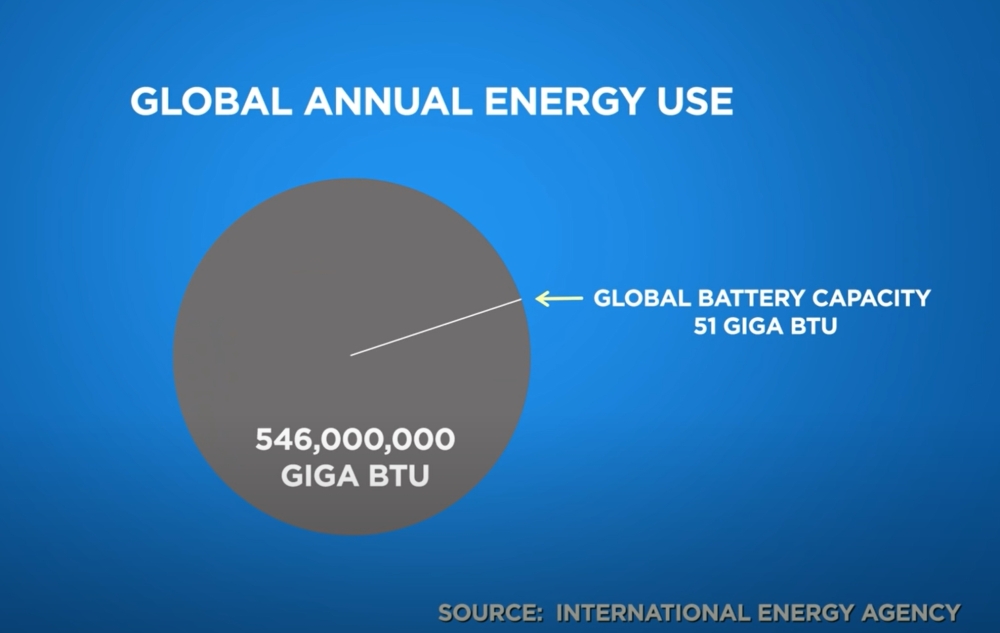
In checking the information, I can’t find International Energy Agency data for “51 giga BTU” of battery capacity anywhere on their site. 546,000,000 “Giga BTUs” is 546,000,000,000,000 BTUs. which is 160,032,600,000,000 watt hours, or around 160,000 terawatt hours.
This is ‘primary energy supply’ – how much energy was generated, but includes the quantity of energy wasted through inefficiency. If you only look at global annual electricity – the field in which batteries play – it’s around 20,000 TWh (they use a similar deception for Germany’s biomass share). So it’s an extra dodgy comparison.
Gibbs has created a self-sustaining argument here. If someone builds a battery storage installation, he can visit the site and monotone sadly about its presence. If someone decides to not build that battery, he can look up the statistics and monotone sadly about the lack of battery capacity.
In an earlier scene, at the launch of the General Motors Chevy Volt (2010, of course), he complains that the cars are being charged by the coal-sodden electric grid of that state – another great example of the infinite loop Gibbs has created for himself, considering his reaction if more wind and solar were built to make that electricity cleaner.
There’s gas, too. They repeatedly claim that shutting down coal plants results in replacement with gas. And in the US, gas has indeed expanded to fill a decent proportion of the gap left by coal:

The UK has a similar thing too, where both renewables and gas are squeezing out coal. But scroll back up to Denmark, above, where a combination of interconnection with other countries, massive wind build-out and coal and gas shutdown has cleaned up the grid. Or Germany, where gas output remains unchanged as coal plants shut down.
There is nothing inherent to renewable energy that makes gas compulsory. All that matter is how the transition is managed. For a long time, gas was sold as a transition fuel, including by organisations like the Breakthrough Institute. But it is becoming increasingly clear that while it might ease change, it isn’t compulsory, and the urgency of decarbonisation has increased.
This film is a long, slow painful monument to laziness
It feels so weird writing about these things again. I feel like I’ve been transported back in time ten years, back to my early days in the renewable energy industry. We’d combat these viral memes every single day.
The industry looks different now. Many wind companies have learnt that insensitive, clumsy development leads to backlash that is harmful for everyone, so they’ve started to clean up their act. Solar developers are figuring out more sustainable pathways than the boom and bust of government subsidies. The human rights issues around mining and materials are becoming more prominent. Renewable companies are taking waste removal seriously.
And then this documentary comes along – a dumb old bull in the china shop that is 2020’s hard-earned climate action environment. There’s a lot of fragile, hard-fought stuff to wreck in there, and Gibbs goes absolutely wild. He’s bulldozing a lot of hard work.

Gibbs obviously has a long-running gripe with biomass, which has a whole range of serious issues associated with it. Though I don’t know the industry well, I suspect many of his gripes there are valid.
But the outright lies about wind and solar are serious and extremely harmful. Wind and solar aren’t just technological tools with enormous potential for decarbonisation. They also have massive potential to be owned by communities, deployed at small scales with minimal environmental harm, and removed with far less impact on where they were than large power stations like coal and gas. They do incredible things to electricity bills, they decentralise power (literally and figuratively), and with more work they can be scaled up to properly replace fossil fuels.
Gibbs isn’t interested in this stuff. No one in 2012 was. He’s armed with a list of dot points from climate denier blog Watts Up With That, and he’s ready to go. The key harm of this documentary is that it does what so many communicators struggle, but fail to do – it presents ideas from one ideological cluster into the world of another. It is very actively and successfully escaping the ‘bubble’, and selling far-right, climate-denier myths from nearly a decade ago to left-wing environmentalists in the 2020s, and going by much of the comments, it seems to be doing well. Gibbs is transcending both time and ideological space, held aloft by a system that provides prominence to mediocrity.
It’s tough to look past how popular this has been. The film’s been boosted because many interviews feature the popular and well-known producer Michael Moore, including on Stephen Colbert’s Late Show. Ludicrously, it received four stars (four. fucking. stars.) in the Guardian, a media outlet normally careful to not boost climate-denier grade misinformation.
All this prominence despite the fact that the film failed to find a distributor, and was dumped onto Youtube instead. “We’ve talked to sales agents. We believe that there will be a tremendous amount of interest in this film… This is going to get distributed. It will be seen”, Moore insisted last year.
It is clear that Gibbs’ starting point was a loathing of biomass, which then turned into a loathing of every single decarbonisation technology (except nuclear power, which isn’t mentioned in the film).
But he ends up at population control – a cruel, evil and racist ideology that you can see coming right from the start of the film. I wish I had the emotional energy to go into it, but I have spent it all. Earther’s Brian Kahn writes:
“There’s a reason that Breitbart and other conservative voices aligned with climate denial and fossil fuel companies have taken a shine to the film. It’s because it ignores the solution of holding power to account and sounds like a racist dog whistle”
The film features a parade of – solely – white Americans, mostly male, insisting the planet has to reduce its population. There is no information provided on which people in the world need to stop fucking, but we can take a guess, based on the demographics of the people doing the asking.


This documentary – particularly the parts on energy, renewables and industry- is extremely bad. It is Jeff Gibb’s 2010 Huffington Post blog drawn out in one hour and forty minutes, which feels like like a decade. I knew it would be lazy, but the magnitude of laziness here is incredible. It it mostly old. It is obviously re-hashing some specific gripes, like its attacks on the nicest guy in the whole of climate activism, Bill McKibben. I feel like I’ve barely scratched the surface and I’m like 2,000 words in. I don’t have the energy to glue together every single fragile thing that this bulldozer has destroyed.
It is the ultimate expression of lazy privilege to make something so void of effort, but so widely viewed and promoted. Criticism will be rebuffed as Not Being Able To Handle The Truth, or the classic We Just Wanted To Start A Discussion. It is still a package of old, dead ideas reheated by someone who knew that he did not need to put any effort into updating his thinking. There was no chance he would be talking to climate activists, talking to young people, talking to experts, talking to community advocates, talking to people from other countries, or really talking to anyone who wasn’t already mostly in his vicinity.
It should have faded off into the pit of Youtube’s unwatched terabytes, but it didn’t, because mediocrity is celebrated, boosted and broadcast if it comes from someone who looks and sounds the right way. That is a serious vulnerability. The hard work of climate and energy advocates, as they grapple with challenges like corporate malfeasance, the impacts of mining and bad development can be shattered by the monotone arrogance of a single person inflicted with the Dunning Kruger effect.
Somber music.
Edit note #1 – 28/04/2020 – A kind commenter pointed out I’d snapped the wrong sub-section of SEGS in the satellite imagery (which explains why I couldn’t find the entrance gate on street view!
Turns out they visited SEGS 1, which stopped generating in ~2015, and was replaced by a facility know as Sunray 2. It is a newer, single-axis tracking PV module system, built in 2015-2016, and has generated 74 gigawatt hours since energisation. They must have visited in the short time between this replacement process. The upgrade meant no emissions on site, lower land use, no water for cooling and a lower environmental impact.
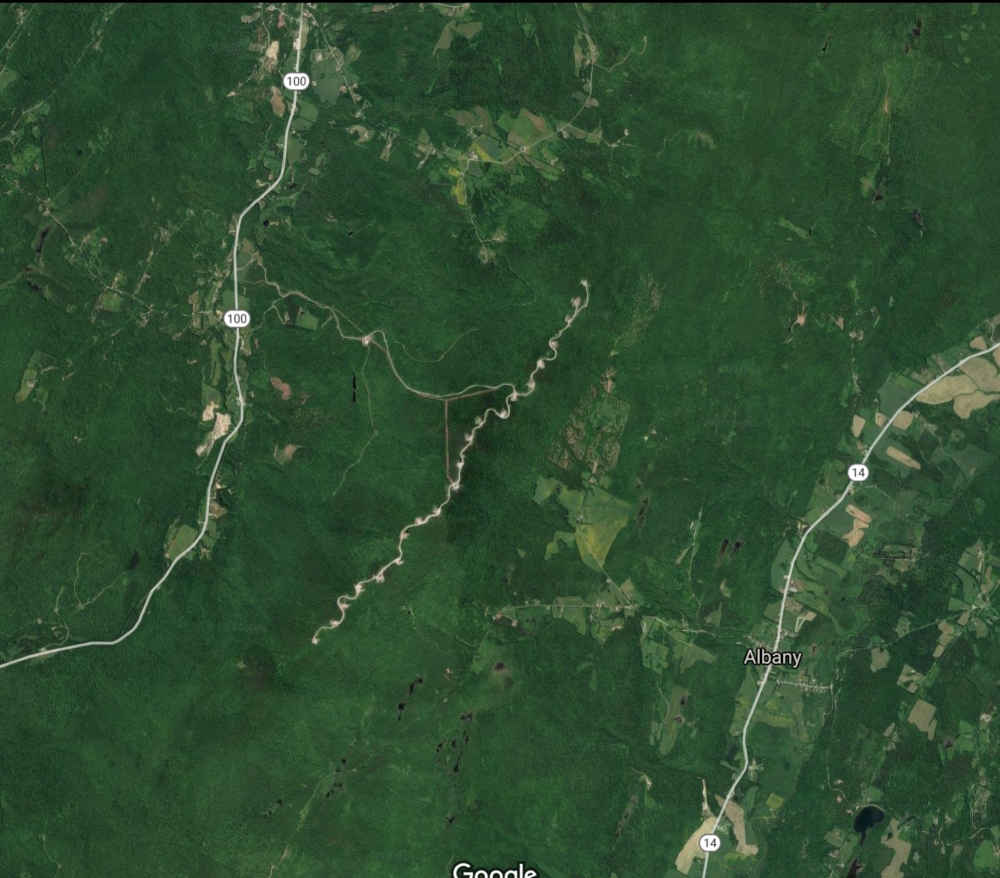
Edit note #2 – 29/04/2020 – I didn’t have time to dig into it, but the site Gibbs visit at the start of the doc is the ‘Kingdom Community Wind Farm’ in Vermont. Gibbs compares the construction of the wind farm to ‘mountain top coal’.
Here’s the completed wind farm (Gibbs’ footage is shot in fog, so there’s no perspective or scale):

And here’s what mountaintop mining looks like:
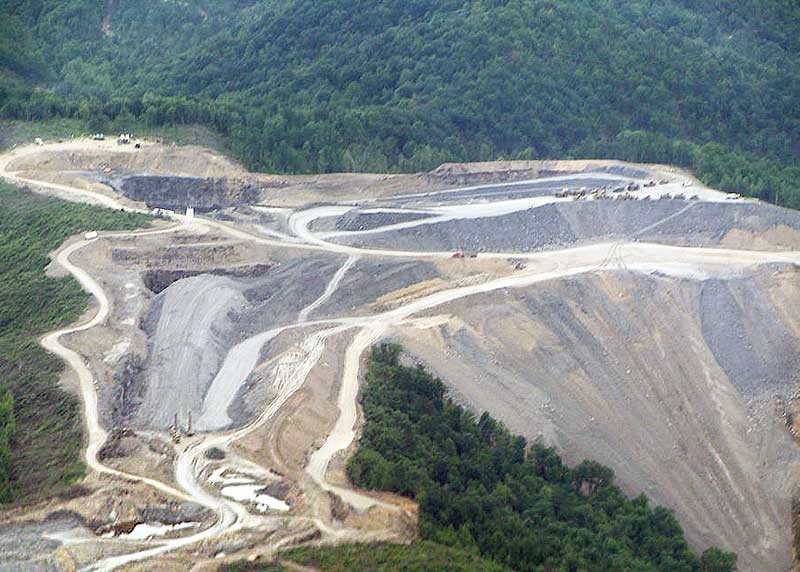
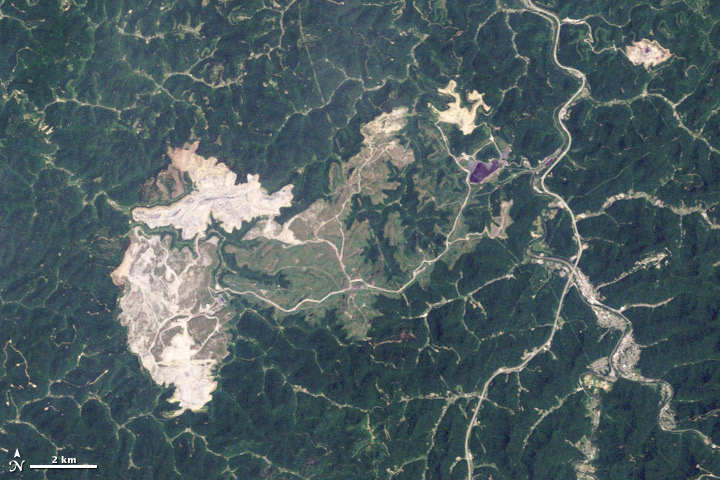
This image of a surface mine in Boone County, West Virginia from 2009.
Based on data from NASA’s Landsat 5 satellite, this natural-color (photo-like) image document the Hobet mine in 2009″ source
They are still paying the local community on a yearly basis. “As part of the Good Neighbor Fund, payments will be made to the following towns: Eden will receive $77,420, Albany $69,885, Craftsbury $33,851, and Westfield and Irasburg each will receive $10,000. The Good Neighbor Fund provides benefits to the five towns within five miles of the project not including the host town, Lowell, which receives significant tax revenue from the project. The payments are determined based on generation”, GMP said in 2016. As of 2019, they’re running regular tours of the site for locals.
“While some are critical of the turbines, Couture, who runs Couture’s Maple Shop and Bed and Breakfast in Westfield, told GMP that he can see the turbines outside his kitchen window, “and I love it. “I love that they are generating local power. My guests at the B&B love watching the turbines – I’ve never heard a negative comment””, wrote a local paper, in 2014. So much for mountaintop mining.
Edit note #3 – 01/05/2020 – Correcting my own edit! A kind reader pointed out Green Mountain Power was sold a few years back, so have removed a sentence that stated it was still owned locally.
Read the next post here
 Ketan Joshi

Thank you for this… I had watched the documentary and was so disappointed and/or discouraged… I worked at the NRTEE back in the 80s and thought, OMG, we’ve accomplished nothing since then… Happy Elizabeth May had a link to your blog.
LikeLiked by 1 person
Spoken like a true Adolph Chump supporter…. Garbage in…. and garbage out. I’ve only been involved with renewables for 50 years now and the Planet of the Humans is spot on. This garbage will make rapists and liars proud….nothing more…
LikeLiked by 2 people
Interesting analysis. Is « laziness » the only reason behind the poor quality of this documentary? Or is there something else? This is playing right into the hands of the climate change deniers? Coming from Michael Moore … that surprises me.
LikeLiked by 1 person
the word capitalism is missing here
LikeLike
ARE YOU HAVING A TESTOSTERONE STORM? tell me. can we find the materiasl, process them, manufacture, and transport photovoltaic cells and wind generators with these same “renewable” energy sources? for example; how can one transport products on solar or wind power?
LikeLiked by 1 person
It’s possible in a limited way. The French railway system runs almost entirely on electricity, and most of their electricity comes from nuclear generation.
LikeLike
although I didn‘t really perceive what this review so strongly criticizes, namely the message that wind and solar are useless and inefficient as such, there might be something to it that I simply missed. I was mainly shocked by the amount of corruption and outright scam happening in the US‘ so called green energy sector, cutting down entire forests to burn as „clean sustainable“ energy etc.
maybe I need to watch it again.
LikeLiked by 2 people
Claude, You didn’t miss a thing. Reading this article just goes to prove that most people are not ready to honestly revise their opinions based on facts. Most of the movie involves facts that have been ” hiding in open view “. It’s a credit to Michael Moore that he was ready to face the music of being tarred and feathered for admitting that he, like many of us, had been taken for a ride by some unscrupulous people.
LikeLiked by 1 person
Paying local parties a small fee as compensation, is a wrong approach, for the local community.
They, residents, should buy family sized lots, of the windfarm, and generate their own power. And use that at home, using net-metering. They would have this power at cost price, about 3 to 4 cents per kWh.
This is the most cost effective way to use windturbines and solar panels, similar to rooftop solar. But most, some, homes are too small to generate enough power for all energy a home needs.
Whether this is possible depends on how local governments protect citizens against investors, and regulations for net-metering
LikeLike
Net-metering is not as great as it looks. The cost of providing reliable electricity when the wind does not blow or the sun does not shine is huge. It’s considerably greater than the cost of the actual energy. In Ontario that cost is lumped in with a variety of other losses and added to our monthly bill as a Global Adjustment Fund contribution. I was offered contracts for both solar and wind schemes. In both cases there was a bad smell about the costing right from the start, over 10 years ago.
LikeLike
Well done for putting the effort into this. I gave up at 30mims into the “documentary” ; posted a list of the inaccuracies and mis-information I’d seen In this short time on the YouTube comments section and did something productive with the other hour of my life I’d have otherwise wasted… NB wrt “need” for population control and common misconceptions recommend people read Factfulness By Hans Rosling
LikeLiked by 1 person
I watched Planet of the Humans and was depressed. I had thought that things were much better in the renewable energy scene these days. I travel in Scandinavia a lot and although the biomass thing bugs me the wind and solar developments were prolific. The burning of biomass is the same as fossil fuel burning. Burning up things that used to be alive. It hardly makes sense to me, but I agree with the writer here about the tone and manipulation factors in the film. Thanks for providing the balance in your critique.
LikeLiked by 1 person
Thanks for providing the balance to the film. I watched Planet of the Humans and was depressed. I had thought that we had come a long way. It is good to learn that the film was based on old information. I do hate biomass use as it exists today. Burning things that used to be alive is the same as using fossil fuels. They used to be alive as well, and it doesn’t make sense to burn more trees when we really need to be planting them to replace what’s gone. We are in a symbiotic relationship with trees and plants so getting rid of them seems dumb. I travel in Scandinavia a lot and am aware of the increasing efficiencies of wind and solar there (mostly wind) and converting garbage to biofuels is big too. Greening the grid seems to be the way to go.
You didn’t get into the implied or perhaps revelaed corruption of Gore et al. Maybe you could comment on that?
Thanks again for the balance!
LikeLike
” Greening the grid seems to be the way to go “. The exact opposite is true. Wind has an efficiency rating of around 28%. Solar only gets about 8%. But when the wind blows and the sun shines, the grid needs to support 100% of plate capacity. Ergo: compared to nuclear or hydraulic generation, the grid needs to be overbuilt by +3 for wind generation, and by 12 for solar. So much for ” balance “.
LikeLiked by 1 person